
5pm Monday through Thursday, THE UNCUT FILMS OF CHARLIE CHAPLIN.
The CineForum, 463 Bathurst Toronto, M5T 2S9. 416-603-6643.
Minimum Donation $10 ($10 under 24).
Learn what was cut from MODERN TIMES: https://www.nitrateville.com/viewtopic.php?t=31209
The first book I read on Charles (Charlie Chaplin) was Robert Payne’s THE GREAT GOD PAN. I can’t recommend it high enough.
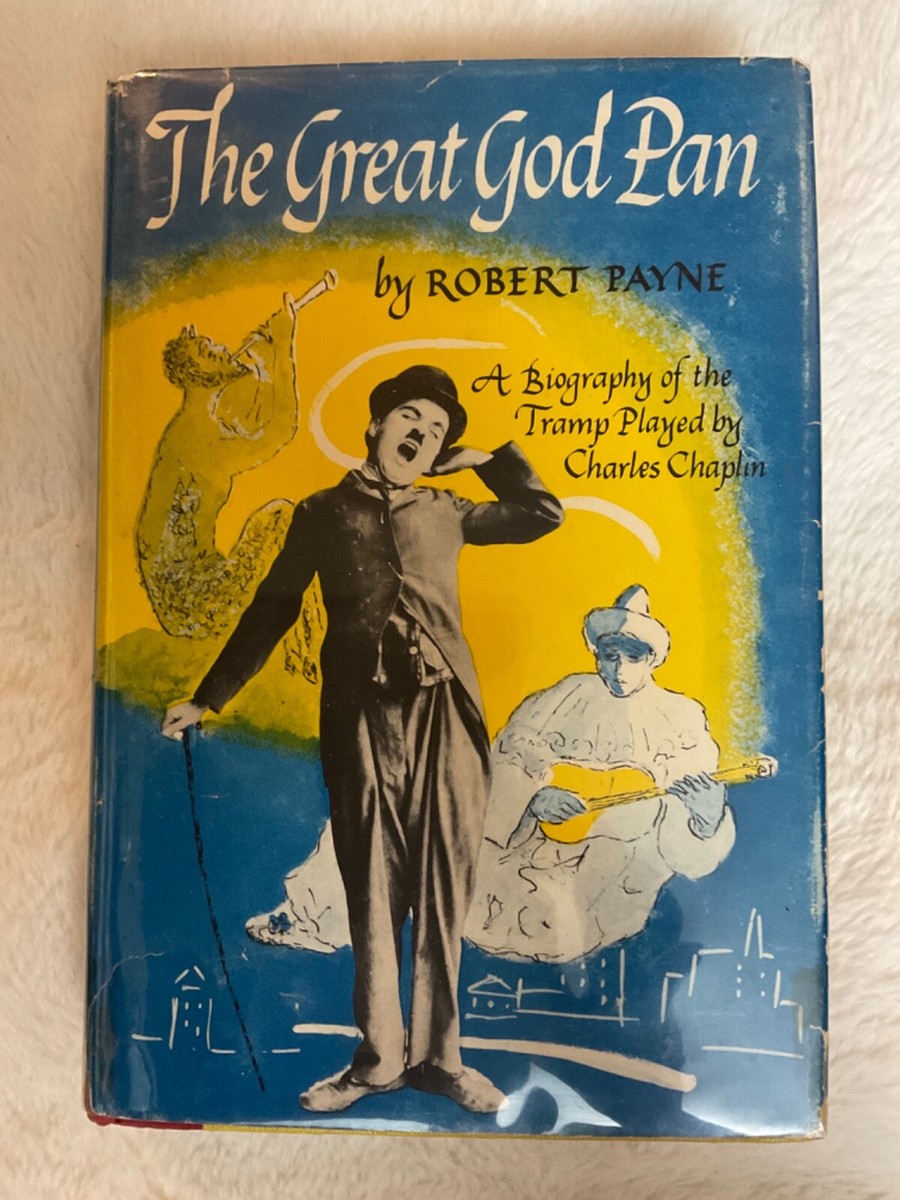 From THE NEW YORK TIMES:
THE GREAT GOD PAN. A Biography of the Tramp Played by Charles Chaplin. By Robert Payne. 28 photographs. 320 PP. New York: Hermitage House. $3.75.
THE title of this new book on the art of Charlie Chaplin is the kind that makes one reader, at least, all but cringe. It smacks of Arthur Machen, James Stephens, or worse. Stephen Phillips. But within a few pages one begins to applaud the author for he has already more than justified his use of such a title: “Who is he? Where does he come from? Where will he go? * * * Charlie blunders and dances through the world, and like Pan he is wholly human, resembling nothing so much as the whole human comedy wrapped in a single frail envelope of flesh.” “What is masterly is the end- less complexity of the character who is never a tramp, never a fool, but resembles most of all a god who has unaccountably found himself on this earth, and having concealed his godlike nakedness with the first clothes he was able to find and wandered unheedingly into the world’s traffic, discovers that the world is completely inexplicable and obeys laws he will not even attempt to understand. “We forget that orgies of clowning were once considered a part of life, and we shall not understand the clowns until we realize they are gods.” In “The Great God Pan,” Robert Payne has produced a fascinating book, an intellectual treat for those who have been entranced by the character of Charlie for almost forty years (throughout, the author is careful to say “Charlie” when he means the beloved figure on the screen and “Chaplin” when he means the artist who created that figure). For those who may be somewhat frightened off by Mr. Payne’s highly intellectual approach, there are twenty-eight wonderful pictures -but in looking at them we must keep in mind that “an airy spirit was contained in the baggy clothes. Charlie’s essential lightness does not appear in the posed photographs.” Unlike most critics, Mr. Payne is well aware of the hazards of analysis, in trying to pin down and put on paper anything so elusive as the magic of Chaplin’s art. But of these very hazards he makes splendid use, and shows there- by the value and need of such a book: “We cannot isolate the comic spirit and hold it up to the light * * * But it is pos-sible that if we could see it steadily for a moment, or thrust through some of the veils where it hides, we might find some of the reasons why it is worth- while to be alive, for tragedy offers only the most excellent reasons why it would be better to be dead. There is a sense in which the genuine spirit of comedy is the lightning-flash which alone illuminates our down-at-heels world.”
THIS review should consist entirely of quotation; this re- viewer would be stumped if he tried to re-say what Mr. Payne says so well. For example: “The art of pantomime is dying, and when Chaplin dies it may be altogether dead. There was a time not very long ago when great gusts of earthly laughter smacked against the vaudeville stage. * * * So it was with the Keystone come- dies. There was nothing smart, nervous or jaded in them; no one was trying feverishly to be funny; the fun lay all around them, and they had only to pick it up. In those days the humor was rich and gay and mocking and atrociously impudent, and it was all these things because there was a human need for them, because a man cannot live without the grace of laughter.”
Beginning with “Shoulder Arms,” a full chapter is devoted to each of the longer films, down to “Limelight,” which is to be released this year. Perhaps the best of these is the brilliant chapter on Chaplin’s much-misunderstood comedy of murder, “Monsieur Verdoux.” “Murder, as Monsieur Verdoux observes, is a serious business and must be regarded seriously, even in comedy * * * For most people, when they attend films. murder is seen as a form of light relief, a pleasant titillation of the senses. *This time there was real murder. * * * It is murder without terror. and therefore the most terrible of all, for that haunting murderer with his charm, his quick mannerisms, his air of indefatigable gentleness and suavity comes very close to us. * * * So Monsieur Verdoux, without committing any murders that we can believe in, concerned with the comedy of murder to the exclusion of the comedy of life, provides a sense of overwhelming menace. We shiver because we know that in our time mur-der is practiced in the real world with the same suavity. the same gentleness and the most exquisite good manners.”