
Leave it to an Italian queer communist to find the humour (life) in a subject (Jesus) so often presented as the most lifeless being who ever lived.
Quietly I loved Bob in his house sitting years.
When we chatted it was clear he still had enthusiasm.
I didn’t know he was house sitting until I read the obituary published in THE GLOBE AND MAIL.
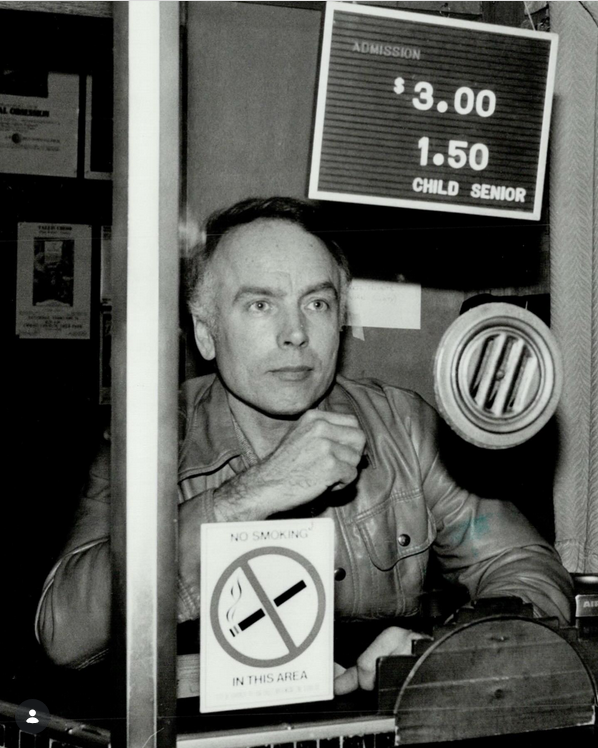
Repertory film pioneer Robert Huber helped establish a culture of cinephilia in Toronto
Listen to this article


Robert Huber died of atherosclerotic heart disease on April 1 at his home in Toronto at the age of 94.John Wood/The Globe and Mail
When Robert Huber began presenting repertory films in Toronto in the mid-1960s, the city was still a cautious movie town. Sunday screenings had only recently been legalized after decades of provincial restriction, the Ontario Censor Board still dictated what appeared on screen, repertory cinema was largely confined to private film societies, and most commercial theatres were devoted to first-run Hollywood releases. Opportunities to watch or rewatch the films of European art-house masters, such as Michelangelo Antonioni, Jean-Luc Godard or Ingmar Bergman, were rare.
Mr. Huber believed audiences deserved better.
Beginning in 1966, he showed Toronto that great films could breathe again on screen. Through a succession of cinemas – the Elektra Theatre, the Cinema Lumière, the Revue and later the Fine Arts – he revived overlooked works, treating film with the seriousness reserved for opera, ballet or theatre. He discouraged late seating once a film began, and resisted selling popcorn.
Mr. Huber helped cultivate the cinephile culture that would eventually make Toronto one of North America’s major cinema cities, years before the arrival of the Toronto International Film Festival (originally known as the Festival of Festivals).
“There were no revival theatres at the time,” said Joseph Medjuck, a long-time friend of Mr. Huber. “Your only choices were to join a film society, or start one of your own,” added Mr. Medjuck, founder of the Cinema Studies Institute at the University of Toronto.
Mr. Huber’s influence still resonates.
In addition to promoting the work of European auteurs, Mr. Huber also recognized homegrown talent. An early champion of David Cronenberg, he programmed the filmmaker’s short films.
“Bob has a massive presence in Toronto’s film history,” said filmmaker Atom Egoyan, who recalled seeing Luis Buñuel’s That Obscure Object of Desire at the Cinema Lumière – one of the theatres Mr. Huber founded – as a “defining moviegoing moment.”
For film producer Camelia Frieberg, revival cinema in Toronto was possible because of visionaries like Mr. Huber. “A trip to the Revue Cinema was a trip worth taking because inevitably you’d see a film you couldn’t see elsewhere or had missed the first time around. There was always a sense of discovery as the lights went down.”
Documentary filmmaker Ron Mann said of Mr. Huber: “My film school was the Cinema Lumière, the Revue, the Fine Arts, and Bob Huber was the dean.”
Robert James Huber was born on April 4, 1931, in Southampton, Ont., the eldest son of Alfred Charles Huber and Mabel Huber (née Shewfelt). A good student, young Bob excelled in painting and was trained in dance and drama. According to his niece Diane Huber, he was close to his mother, but feared his father. He used cinema to escape a difficult childhood.
“When I was a small child, our next-door neighbour took me on the train to Port Elgin to see Snow White and the Seven Dwarfs,” Mr. Huber said in March, in what would be his final interview. “Later, when I was in high school, I went to see practically everything that was shown at the Esquire Theatre in Southampton. I can remember the Alice Faye and Busby Berkeley musicals.”
In his 20s, Mr. Huber worked as an actor, performing alongside Donald Sutherland in a production of The Rainmaker in Gravenhurst in 1957.
After an injury ended his stage career, he found work freelancing for CBC Radio, producing segments for the show Ideas, and briefly hosting a classical music show where he recited poetry.
Mr. Huber was a member of the Toronto Film Society, but resigned from its programming committee in 1966 over policy disagreements. He had bigger plans.
At the corner of College Street and Brunswick Avenue stood the Elektra Theatre, an Art Deco gem built in 1937 that specialized in Greek films. “They just operated on the weekends,” Mr. Huber said. Independent filmmakers and film festivals rented the space on weeknights.

The Elektra Theatre at 362 College St. in Toronto, some time between 1966 and 1968.Stan Bevington/Supplied
In the fall of 1966, after the teleplay he wrote for an adaptation of August Strindberg’s Miss Julie was broadcast on CBC Television, Mr. Huber arranged to rent the cinema four nights a week for repertory films.
“As I remember it, Bob was paid what seemed like a lot of money to us at the time and [he] probably used that to start booking the Elektra,” Mr. Medjuck recalled.
His first screening, on Oct. 3, was Mr. Antonioni’s Red Desert, which had never played commercially in Toronto. “Monday night’s houses for the two shows were small enough to be described as minuscule,” wrote the Toronto Star. Over time, Mr. Huber built a following.
Stan Bevington, founder of Coach House Press, printed newsletters for regulars and remembers Mr. Huber as a careful proofreader and meticulous typesetter. Mr. Bevington recalls that the cinema had seen better days. “It wasn’t exactly plush seating. It was pretty economical from what I remember. He let me come for free.”
Within months, an article in The Globe and Mail said, the success of the Elektra’s screenings was evidence of an “upsurge of interest” in commercial repertory film programming.
But his weeknight runs denied Mr. Huber the lucrative weekend box office, when the cinema’s owners screened other films. He left the Elektra in August, 1968. “If something wasn’t working, he moved on,” said Faggie Oliver, a lifelong friend who met him in 1967.
In the fall of 1969, Mr. Huber and his partners leased a cinema on College Street near Spadina Avenue, then operating as Cinecampus, a sexploitation house with a concrete runway for live shows.
“When we opened Cinema Lumière, we had to take out the runway that the strippers used. We went through a lot of expenses,” Mr. Huber said.
Curt Oliver, who is married to Faggie Oliver, remembers painting the interior of Cinema Lumière before its opening screening of Mr. Antonioni’s Eclipse, on Dec. 17, 1969. Mr. Huber’s curatorial vision was to show an underappreciated film for three days, then replace it with another worthy of the cinema’s screen. In its first month, Cinema Lumière ran films by a mix of European and American directors including Joseph Losey, Federico Fellini, Mr. Godard, François Truffaut and Peter Bogdanovich.
Piers Handling, former director and CEO of the Toronto International Film Festival, had a transformative experience at Cinema Lumière. He was transfixed by Mr. Godard’s early films while a student at Queen’s University in Kingston.
“When I found out the Lumière was screening [Godard’s] Two or Three Things I Know About Her, I took the bus down and back for a day to see the film,” Mr. Handling recalled.
Mr. Huber’s new cinema struggled financially, however. So, in the spring of 1971, Cinema Lumière entered into a partnership with Premier Operating, a company with deep roots in Canadian film exhibition.
“It was a mistake,” Mr. Huber said in a recent interview.
The cinema booked Chariots of the Gods, a popular documentary alleging that ancient technologies could have come from extraterrestrial visitors. This decision led to a programming dispute between Mr. Huber and his partner, Murray McQuarrie, who sided with Premier.
“They just kept running it,” Mr. Huber said. “I had planned a summer festival. I told him that if my festival was cancelled in order to keep Chariots of the Gods running, I was out. And that’s what happened.”
Mr. Oliver winced at the mention of Chariots of the Gods. “I’ve harboured some guilt over that for years because I was the one who introduced him to the movie.”
After Mr. Huber walked away, Cinema Lumière installed a popcorn machine, and the cinema became profitable. “Murray was happy to be making money,” said Gary Bluestone, a Cinema Lumière employee. Mr. Bluestone followed Mr. Huber to the Revue, on Roncesvalles Avenue. There, Mr. Huber and his friend Paul Ennis, a musician and critic, took over the theatre in December, 1972.
Needing cash, they turned to friends. “We mortgaged our Volvo,” Ms. Oliver said. “We loaned them $1,000, which helped with the newspaper advertising.”
The rejuvenated Revue flourished, becoming one of Toronto’s revival film destinations over the next dozen years.


The exterior of The Revue Cinema, located at 400 Roncesvalles Ave. in Toronto, in October, 2024.Duane Cole/The Globe and Mail
Mr. Huber spoke fondly of his partnership and friendship with Mr. Ennis, recalling how their programming at the Revue reflected – and played off – their respective film tastes. They purchased the building in 1978, one year after they opened the Fine Arts Theatre.
The new venture, housed in the former Capitol Theatre, near Yonge Street and Eglinton Avenue, specialized in first-run art films, a long-time aspiration for Mr. Huber. It was a partnership between Mr. Huber, Mr. Ennis, and Linda Beath, head of New Cinema Enterprises, a distributor of foreign and art films.
By the mid-1980s, as multiplex cinemas ascended, the repertory landscape Mr. Huber helped pioneer was shifting. In 1984, the Revue was sold and absorbed into the Festival Cinemas chain of neighbourhood theatres, while the Fine Arts closed when Famous Players reclaimed the space. The operation relocated to an old theatre on St. Clair Avenue West, renamed the Fine Arts St-Clair, but shut down in August of that year.
Mr. Oliver spoke to the Toronto Star at the time about the struggles in securing independent, foreign and art-house titles. “We didn’t have access to films like the other big theatres,” he said.
After the Fine Arts St-Clair, Mr. Huber retired from screening films. “The business had changed so much,” Ms. Oliver said. He spent his remaining working years as a house-sitter.
“Bob did so much for the industry,” said film programmer and concert promoter Gary Topp, who pioneered midnight movies at the Roxy Theatre in the 1970s. “He took chances with movies that people didn’t think were worth showing.”
In recent years, Mr. Huber was reclusive, but kept in touch with friends and family. Mostly, he watched movies. One Battle After Another was his favourite film from 2025. “If he didn’t answer the phone, he was watching a movie,” his niece Diane Huber said.
Mr. Huber’s home video collection spanned entire walls of his living room.
“The biggest project in his final years was upgrading his collection from DVD to Blu-ray,” Mr. Oliver said. Mr. Huber looked forward to his monthly visits to Bay Street Video, one of Toronto’s last remaining video stores. Staff remember Mr. Huber as “warm and endlessly curious.”
“For all his towering knowledge,” said Mark Hanson of Bay Street Video, “he was always more interested in listening to what others thought about cinema, taking our recommendations and then following up after he’d watched them.”
Mr. Huber kept up with film magazines. “I had written a piece on a contemporary Indonesian filmmaker,” Mr. Hanson said. “Bob came in and told me how much he enjoyed the article, and that he wanted to seek out the films discussed since it was an area he wasn’t too familiar with. It was this generous and inquisitive spirit that will always stick with me.”
Of the theatres where Mr. Huber left his mark, only the Revue still screens films. Operated by the not-for-profit Revue Film Society since 2007, it will host a memorial screening for Mr. Huber on June 15.
« THE VILETONES at The CineForum aka THE PUBLIC ENEMY One night only: Reg Hartt on THE FOUR HORSEMEN OF THE APOCALYPSE (1921) »