
THE BIRTH OF A NATION (1915) is not a racist motion picture. Neither was DavidWark Griffith.
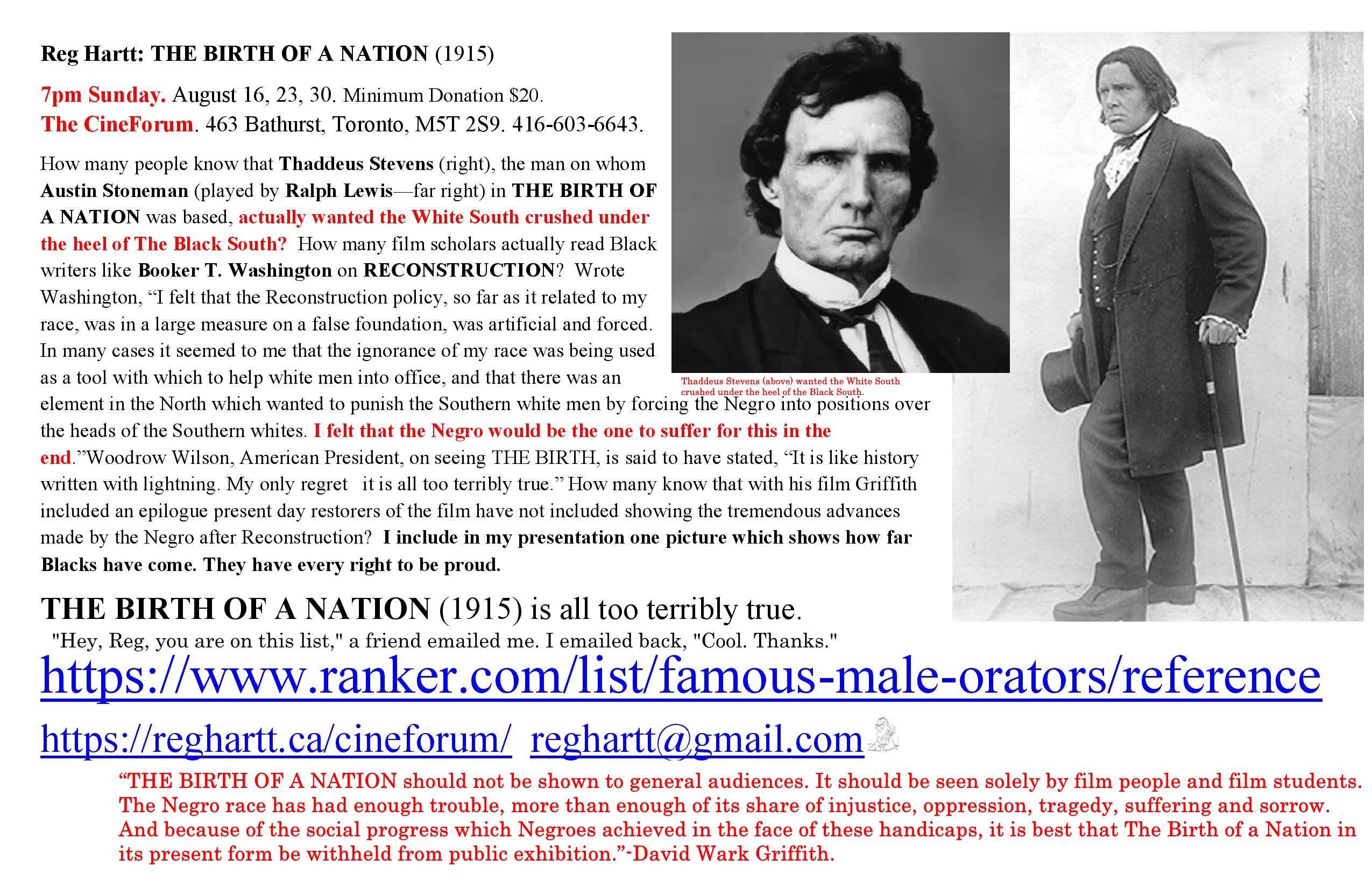
“Though I was but little more than a youth during the period of Reconstruction, I had the feeling that mistakes were being made, and that things could not remain in the condition that they were in then very long. I felt that the Reconstruction policy, so far as it related to my race, was in a large measure on a false foundation, was artificial and forced. In many cases it seemed to me that the ignorance of my race was being used as a tool with which to help white men into office, and that there was an element in the North which wanted to punish the Southern white men by forcing the Negro into positions over the heads of the Southern whites. I felt that the Negro would be the one to suffer for this in the end.”–Booker T. Washington, UP FROM SLAVERY (1901).
The Revived KKK was anti-Irish, anti-Italian, anti-Jew, anti-Roman Catholic, as well as anti-Black and anti-everything else that was not them.
The original KKK, though not created by the Democratic Party, was a vigilante force endorsed by many in The Democratic as means to deal with forces in the Republican Party who were determined to use the Negro (as Booker T. Washington states above) as a means of crushing the White South.
As an Irish, Roman Catholic kid I grew up experiencing hate. As my mother was Anglican I grew up experiencing the hatred of some Catholics for my “mixed” blood (Mixed meaning Roman Catholic/Anglican). That’s something I am glad for.
Describing, as many do, THE BIRTH OF A NATION (1915) as an evil film, as a racist film is letting those who used the Negro to crush the South off the hook.
Not only that it is tarring and feathering the picture’s producer/director/writer David Wark Griffith.
I am not alone in saying the picture is not racist. Neither was its director.
This summer digging through old newspapers on line I learned that THE BIRTH OF A NATION (1915) ended with footage now missing from all Restorations which showed the incredible progress made against great obstacles by the Negro.
Further I learned that Griffith not only publicly stated slavery was wrong he also stated that his picture in its present form (shortened from 3 hours 15 minutes to under 90) should be withdrawn.
Griffith stated, “The Negro race has had enough trouble, more than enough of its share of injustice, oppression, tragedy, suffering and sorrow. And because of the social progress which Negroes achieved in the face of these handicaps, it is best that The Birth of a Nation in its present form be withheld from public exhibition.”
This is the statement of a responsible person.
David Wark Griffith made THE BIRTH OF A NATION was an independent picture. It was a picture the industry had no faith in.
Contrary to a specious BBC post ( https://www.nitrateville.com/viewtopic.php?t=19597 ) “’It was a box office success – a mainstream film, so utterly mainstream, says Professor Alan Rice, a Birth of a Nation expert at The Institute for Black Atlantic Research at the University of Central Lancashire, who has been organising a series of symposia on the film.”
THE BIRTH OF A NATION was utterly not a mainstream film.
“A mainstream movie is a commercial film made by major studios to appeal to a large, general audience. These movies feature big budgets, famous actors, and heavy advertising. They focus on wide theater releases and popular themes like action or romance rather than artistic experiments.Key FeaturesBig Studios: Backed by major Hollywood or global production companies.High Budgets: Large amounts of money used for production and special effects.Mass Marketing: Promoted heavily on TV, billboards, and the internet.Famous Cast: Stars well-known, A-list actors. ” https://www.seamedu.com/blog/What-is-the-difference-between-mainstream-and-independent-films
“The Birth of a Nation relied entirely on the cinema for its success, for it carried no well-known names as a box-office attraction. It stood alone as a film; and as a film it was triumphant… the importance of the film lay in its achievement of attracting the notice of serious-minded people to the expressive power of the cinema. Its merits are to be appreciated, not individually, but as a whole.” –Paul Rotha, THE FILM TILL NOW (1930)
The only director in our time comparable to Griffith was Stanley Kubrick. I said comparable. I did not say equal.
Griffith stands alone. He was reviled by other film producers at the start of his career. He is reviled today by film makers who swim with the flow instead of against it which truly great artists always do.
« 11:59pm Saturday, Aug. 15, 22, 29: THE BEST OF THE SEX & VIOLENCE CARTOON FEST 2pm Sunday, August 16: Grim Natwick Animation Feastival »