
D. W. Griffith’s THE BIRTH OF A NATION (1915) Saturday, May 3, 10. 7pm. Minimum Donation $100.00.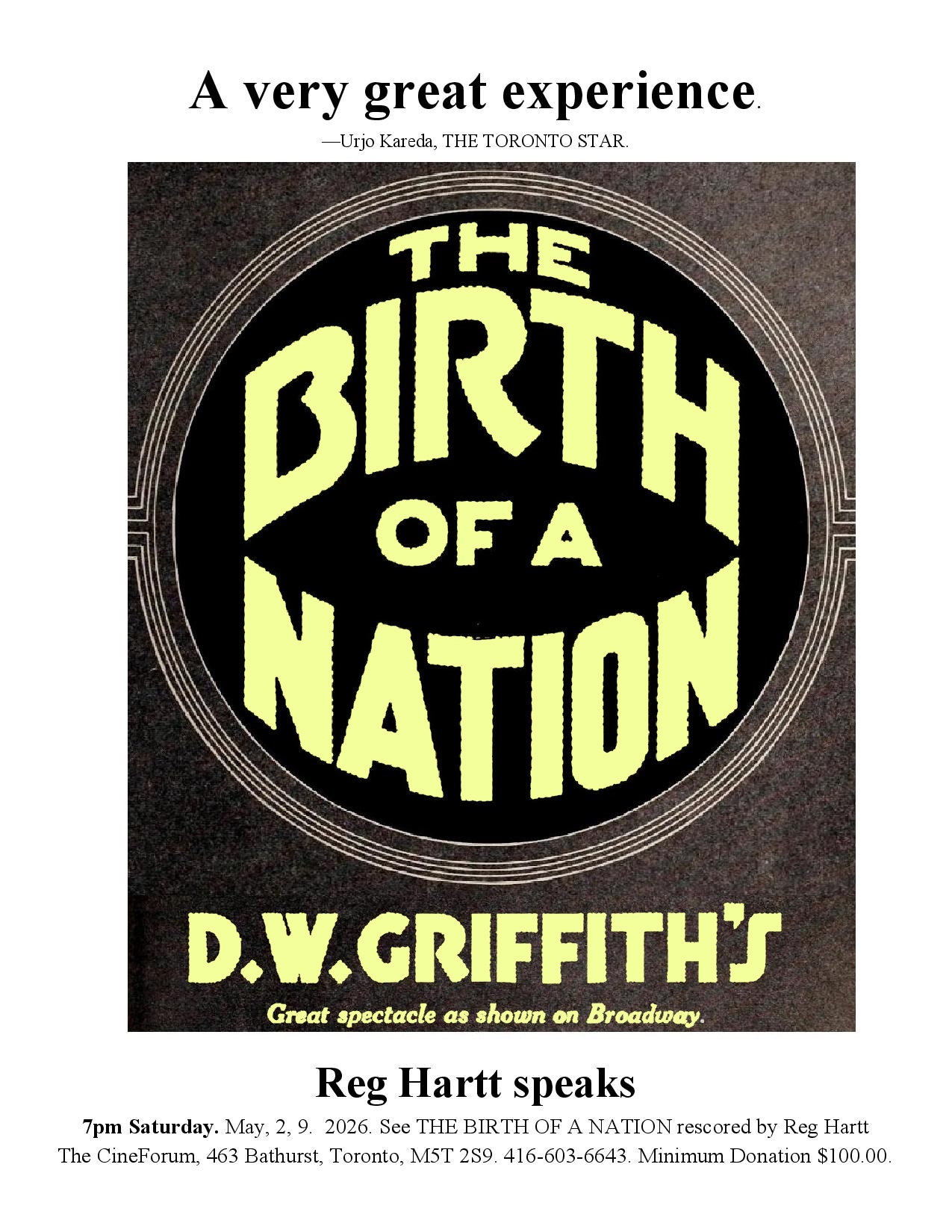
In a 1941 session with a would-be biographer, Griffith said of THE BIRTH OF A NATION, “It should not be shown to general audiences. It should be seen solely by film people and film students. The Negro race has had enough trouble, more than enough of its share of injustice, oppression, tragedy, suffering, and sorrow. And because of the social progress which Negroes achieved in the face of these handicaps, it is best that The Birth of a Nation in its present form be withheld from public exhibition.”
A friend has asked to see THE BIRTH OF A NATION.
Griffith is attacked by many today. I am not one of his attackers.
Seymour Stern, in FILM CULTURE, wrote at greater depth than any one until William M. Drew came along. Both did their homework.
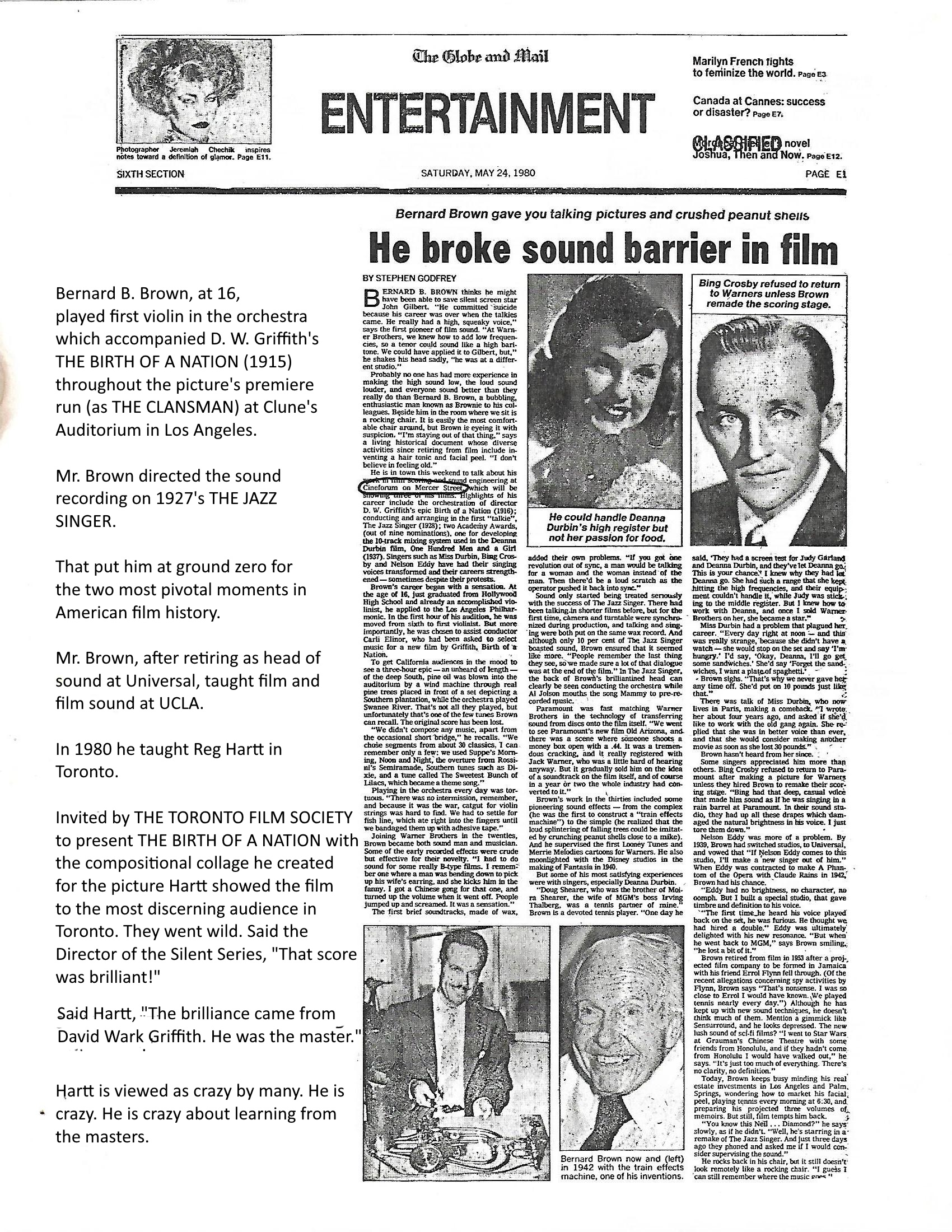
In 1980 I brought motion picture sound pioneer Bernard B. Brown to Toronto. He had played first violin in the orchestra which accompanied THE BIRTH through it premiere run at Clune’s Auditorium in 1915. Mr., Brown was head of sound at Warner Brothers and then at Universal. On retiring he taught film and film sound at UCLA.
For three great days in Toronto Bernard B. Brown taught me.
THE BIRTH OF A NATION was the first motion picture presented at Legit Theatre prices.
The industry and the media said the public would not pay legit theatre prices for a movie.
The public did.
People today pay $100 to sing-along at THE ROYAL ALEXANDRA THEATRE in Toronto.
Roger Ebert stated, “Griffith demonstrated to every filmmaker and moviegoer who followed him what a movie was, and what a movie could be.”
He did that by raising the movies from the equivalent today of THE 99 CENT EL CHEAPO to THE PRINCESSS OF WALES THEATRE.
To experience this picture properly that is how this picture must be experienced.
If you do not agree, fine.
Progress is made by leaving people behind.
Progress is not made by corporations.
Progress is made by individuals.
Ebert writes, “Griffith and ‘The Birth of a Nation’ were no more enlightened than the America which produced them. The film represents how racist a white American could be in 1915 without realizing he was racist at all. That is worth knowing. Blacks already knew that, had known it for a long time, witnessed it painfully again every day, but “The Birth of a Nation” demonstrated it in clear view, and the importance of the film includes the clarity of its demonstration. That it is a mirror of its time is, sadly, one of its values.”
I seem to be the only one today who recognizes the importance of turning our back on the motion picture industry. Industry creates product.
Product is not art.
Ebert writes, “allow me to rewind to a different quote from James Agee: “The most beautiful single shot I have seen in any movie is the battle charge in ‘The Birth of a Nation.’ I have heard it praised for its realism, but it is also far beyond realism. It seems to me to be a realization of a collective dream of what the Civil War was like… I have just looked at the battle charge again, having recently endured the pallid pieties of the pedestrian Civil War epic ‘Gods and Generals,’ and I agree with Agee. Griffith demonstrated to every filmmaker and moviegoer who followed him what a movie was, and what a movie could be.”
That is the vision that leads me: what a movie can be.
See THE BIRTH OF A NATION at The CineForum with he score prepared for it by myself.
I do my homework.–Reg Hartt
https://www.rogerebert.com/reviews/great-movie-the-birth-of-a-nation-1915
« CARTOON LOGIC: FAMOUS STUDIOS CHAMPION COLLECTION THE PUPPETOON MOVIE DIRECTOR’S CUT BLU-RAY »