


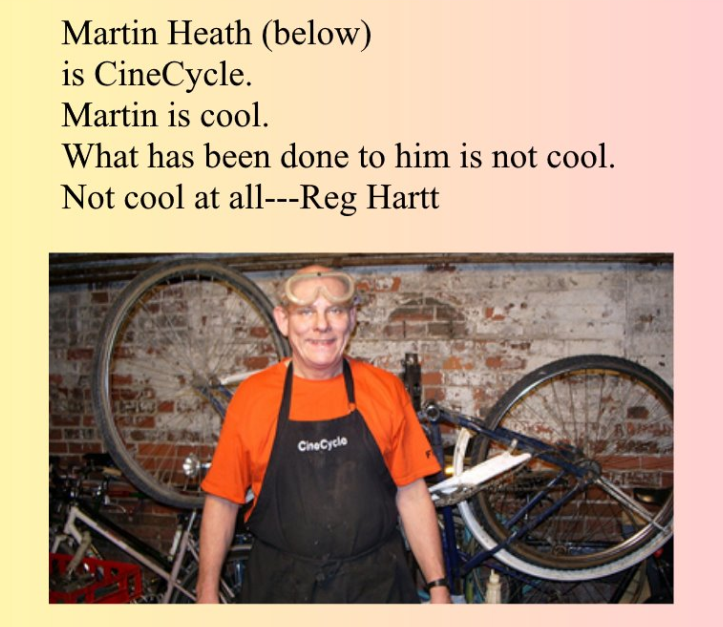
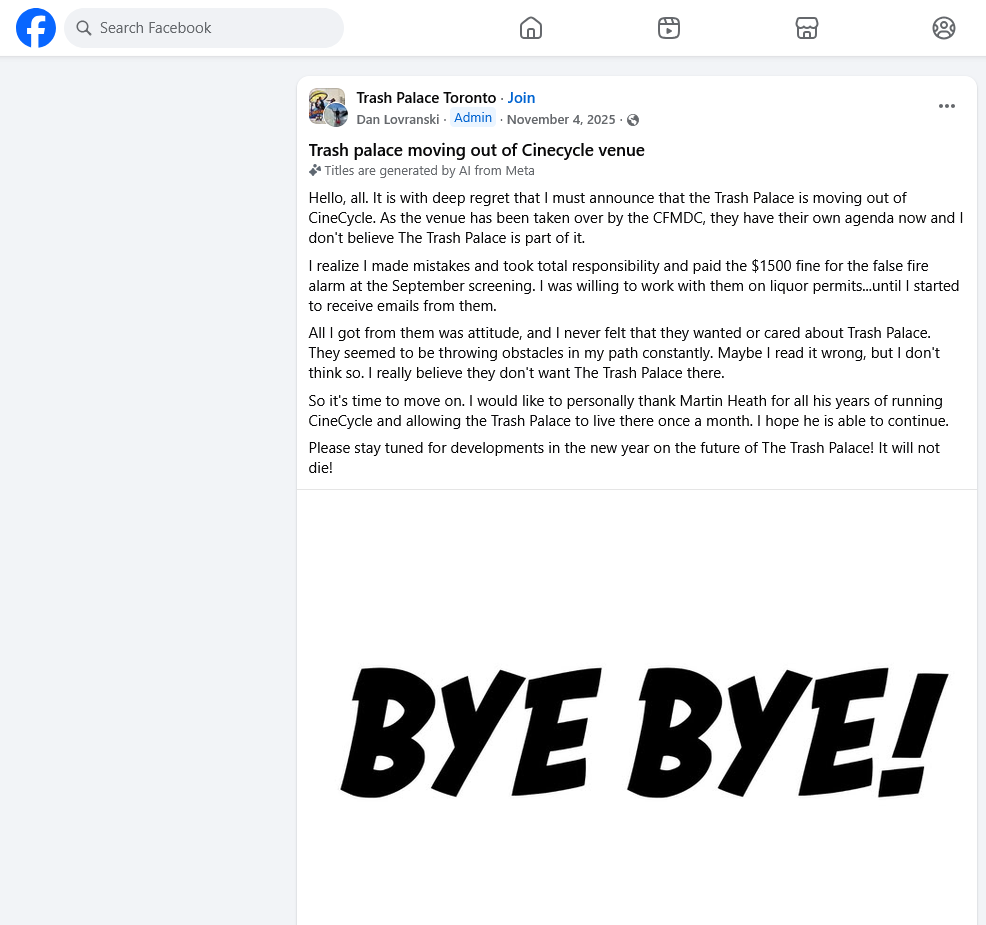
Stacy Case’s THE TRASH PALACE won’t be holding events at Martin Heath’s CineCycle anymore. Primarily because Martin Heath got his ass kicked out of his space by bandits.
They not only robbed him of his venue, they trademarked the name “CINECYCLE” which means Martin can’t use it.
Let them have the venue.
We must not let them have the name “CineCycle.”
Sheila has one of the sharpest minds in the world. I have documented her CINECYCLE performances (at no charge to Sheila. I love her work.).
Here is one: https://www.youtube.com/watch?v=NOMh0w8PWbI .
Another is Petunia who is setting the world on fire with his music: https://www.youtube.com/watch?v=_87ZvUFtQyc , https://www.youtube.com/watch?v=3QCLcOr0NNU , https://www.youtube.com/watch?v=tSWVh6r_o3o .
I first met Martin Heath at Rochdale. Martin was/is cool.
I first met the CFMDC in Rochdale. They were full of attitude then.
According to Stacey Case they are brimming with attitude now.
Something wonderful has died in Toronto.
https://en.wikipedia.org/wiki/Henri_Langlois
Martin Heath’s CineCycle: A History
by John Porter, published in Lola #10, Fall 2001, Toronto
Martin Heath has been committed to film and bicycling ever since he was a teenager in England in the early 1960s. He has worked as a film print handler, projectionist or cinema builder for many notable organizations in London, UK and Toronto. His personal projects have included: his 100-minute film “The Son of Tutti Frutti” which played weekly at the Roxy Cinema in Toronto in 1972; his and Chris Clifford’s inflatable Mobile Cinema which toured Ontario for 3 summers (1976-1978); and collecting 2,000 films and 50 projectors. But Martin Heath is probably best known as the owner and operator of CineCycle, an underground cinema and bicycle repair shop in Toronto since 1991.
The creation of CineCycle has taken several forms, initially in the late 1970s when Heath was working with a group of artists in A Space at 466 Bathurst St. They built an art gallery with a projection booth and folding risers where Heath and Tom Dean presented Sunday night film screenings for A Space gallery. They had an espresso bar and darkroom, and Heath provided a bicycle repair service. He also built a bicycle-powered, super 8 projector for a Western Front performance at A Space.
In 1979 Heath and artist Chrysanne Stathacos rented 11 Grange Ave., an abandoned factory in the lane behind #13, and formed Grange Arts and Performance (“The GAP”) with a board of directors. They were public for 7 months but after a loud New Years party their neighbours got a court injunction against them. Heath remained there for 9 more years, fixing bicycles and working at the Toronto International Film Festival since it began in 1976, Marc Glassman’s 1984 Forbidden Film Festival, and the Macadamian Film Society screenings every Sunday night at the Rivoli 1982-1987. At the same time in Toronto, alternative screenings and performances were plentiful at the The Funnel Experimental Film Theatre, 1977-1988, and at the Euclid Theatre for Independent Film and Video, 1989-1993, which Heath had helped to build. But both those theatres were publicly funded, while Heath prefers more spontaneous and underground programming that he can only achieve with self-financing.
In 1989 he rented 317 Spadina Ave., an abandoned factory in the lane behind #321. It had a lot of potential which was never realized because the landlord was unsympathetic, and the rent was high. Heath formed Access Bicycle Works – an ambitious plan for a bicycle repair co-op, and in March 1991 he opened CineCycle with a series of parties. The front half was a bicycle repair shop and espresso bar which guests walked through to the 80 seat cinema, which he rented out, and the whole space was crowded with old bicycles and equipment, and over-run with cats. Its projection formats include 35mm, 16mm, 8mm, 9.5mm and super 8 film, and video, the only such cinema in Toronto. It was featured in the press, quickly became popular and was busy for 4 years with regular or special screenings, performances, parties and meetings by a variety of groups and organizations, many of them publicly funded, and independent filmmakers.
Heath’s “Silent Sundays” presented weekly screenings of classic “silent” films from his collection, with live piano accompaniment by John Henry Nyenhuis. Some of the feature-length films were 8mm copies for which artist Petra Chevrier custom-built Toronto’s only Xenon-lamp 8mm projector, with 2,000 foot reels. Toronto’s film co-op L.I.F.T. used CineCycle for its monthly screenings of members’ films, and the Innis Film Society (later Frames Per Second) used it for some of their screenings and guest appearances by “avant-garde” filmmakers. Pleasure Dome Artists’ Film Exhibition Group has used CineCycle regularly since it opened, bringing many notable film and video artists from around the world. CineCycle had a small stage in front of the screen which was used often by stand-up satirist Sheila Gostick and by the Shake Well Performance Art group. In 1994 the Inside Out Lesbian & Gay Film & Video Festival used CineCycle for many of its screenings.
In 1995 Heath moved CineCycle to its present location – the former coachhouse of 401 Richmond St. W., in the lane behind 129 Spadina Ave. The landlords are sympathetic and the “401” building is occupied by many alternative arts groups. The old coachhouse required a lot of major work which is still continuing, but CineCycle has attracted many regulars who have volunteered to help over the years. The space is smaller so Heath must clear the cinema to repair bicycles, and there is no stage but Heath says one is possible.
In 1996 fellow film collector Reg Hartt brought his twice-weekly Cineforum screenings to CineCycle for 6 months. L.I.F.T.’s monthly members’ screenings were again held at CineCycle 1998-2000, the Toronto Animated Image Society began using CineCycle for screenings in 1998, and Advocacy for Respect for Cyclists began in 2001. Pleasure Dome continues to use CineCycle regularly, including for its annual outdoor Open Screening in the “401” parking lot or courtyard, which can run on for hours. Pleasure Dome co-founder Jonathan Pollard has screened films and videos from his own collection at CineCycle several times, and since 1999 he and Heath have organized Home Movie events including repair clinics, open screenings and screenings of the 90-minute, 16mm home movie “The Catherine Films” (1937-1952) which they had found and returned to the original owner after it had been lost for 45 years. The story of “The Catherine Films,” a complete list of Pleasure dome programs, and many photographs of CineCycle appear in Pleasure Dome’s 10th anniversary book “Lux” (2000).
Now in his 50s, Martin Heath is bicycling more than ever. In 1998 he became the world distance record holder for Brevet de Randonneur Mondiaux (BRM) bicycle rides, cycling 9,780 kilometres in one year.
Now in 2026 Martin is being treated truly shitty.
I first learned of this from Cleo Halfpenny this week.
Saturday morning I gave Sheila Gostick a call.
Martin Heath is about so much more than movies.
–Reg Hartt 20-07–2026.

« Honouring Steven Leckie. AN IRISH WAKE FOR MARTIN’S HEATH’s CINECYCLE (With Martin TIFF would not exist). »