https://www.nitrateville.com/viewtopic.php?t=19597
The Birth of a Nation: The most racist movie ever made? Tom Brook (Epoch Producing Corporation)
D. W. Griffith’s film was released on 8 February 1915. A century later it’s regarded as a landmark in cinema history – and terribly bigoted. Tom Brook reports.
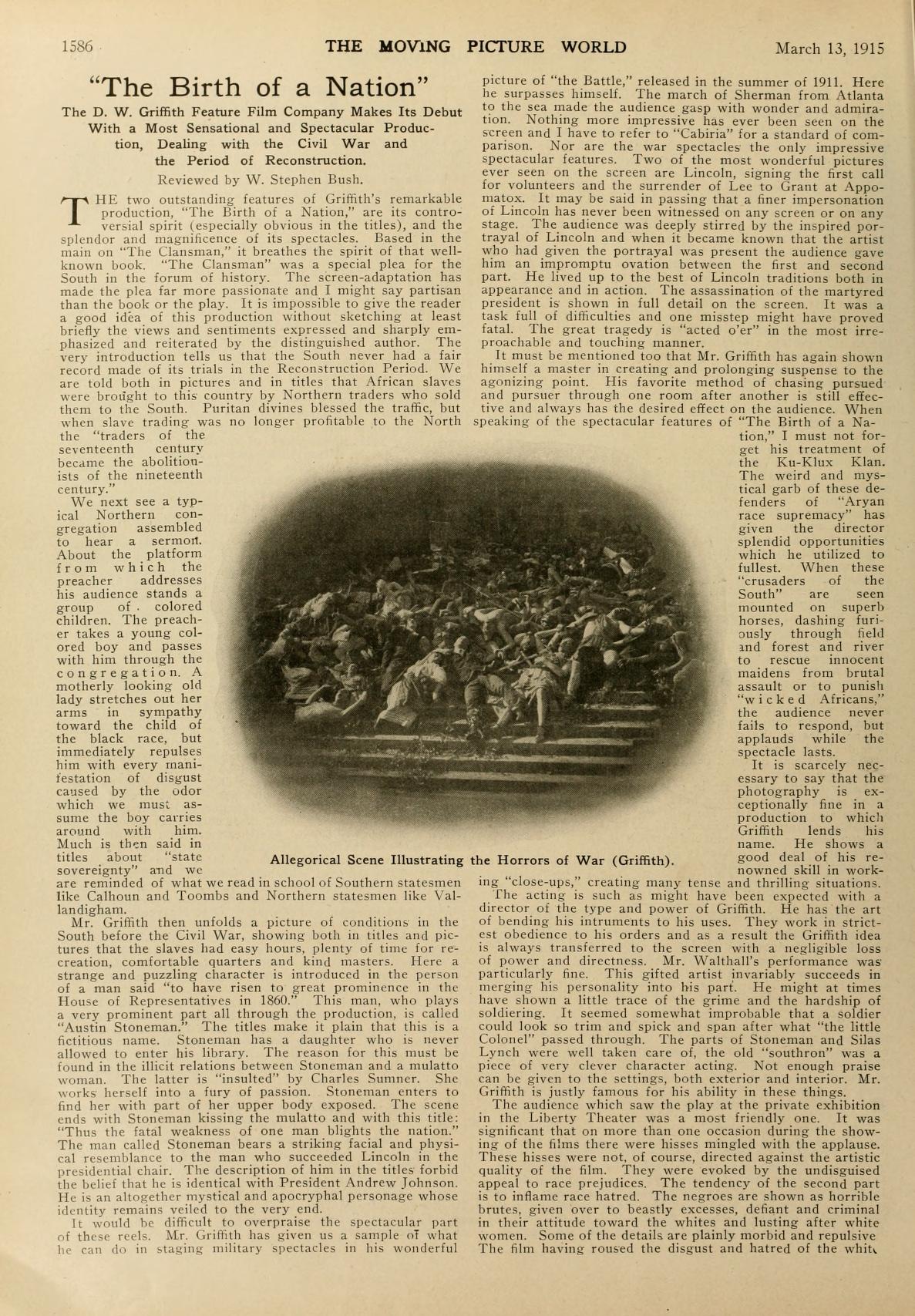
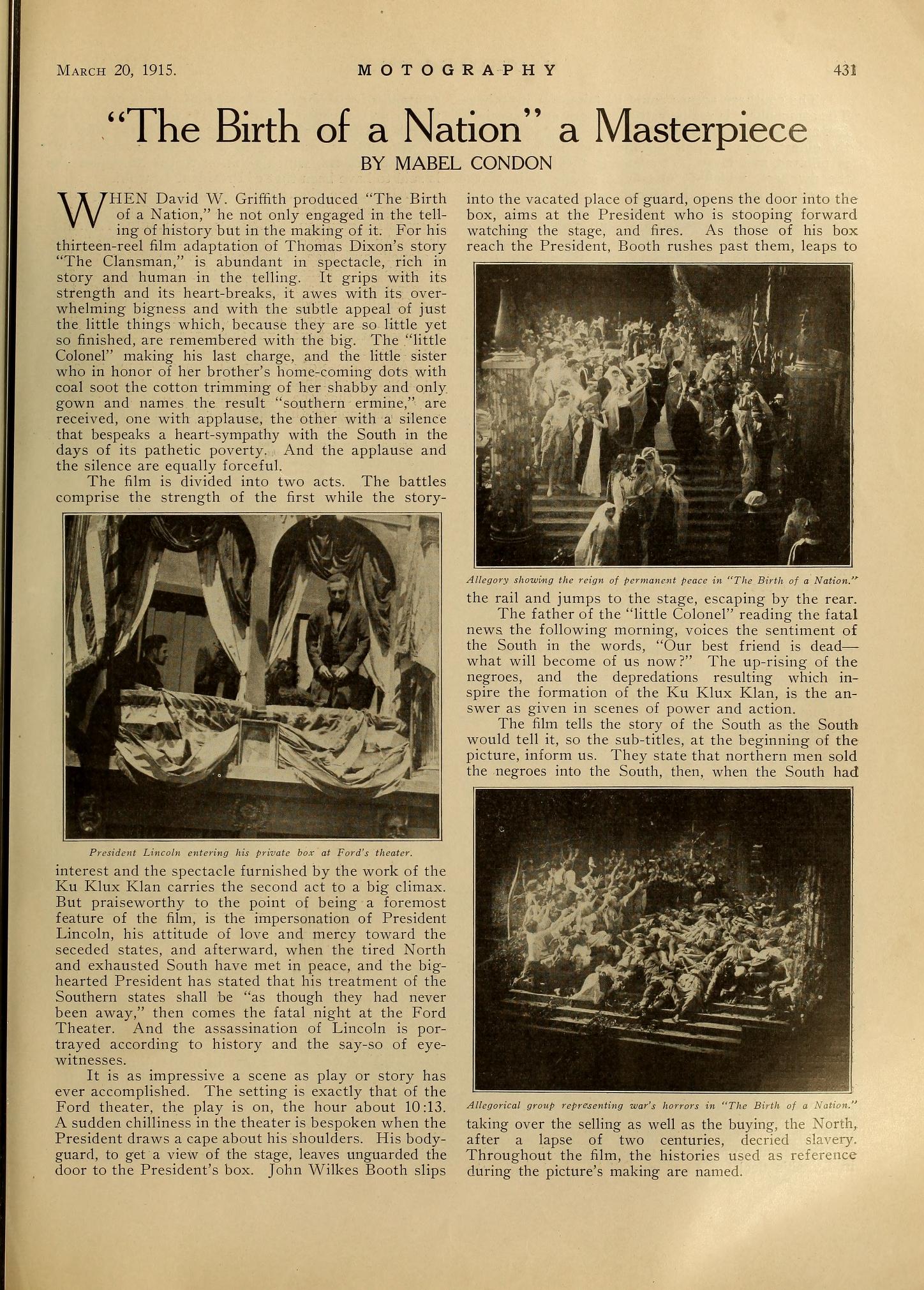
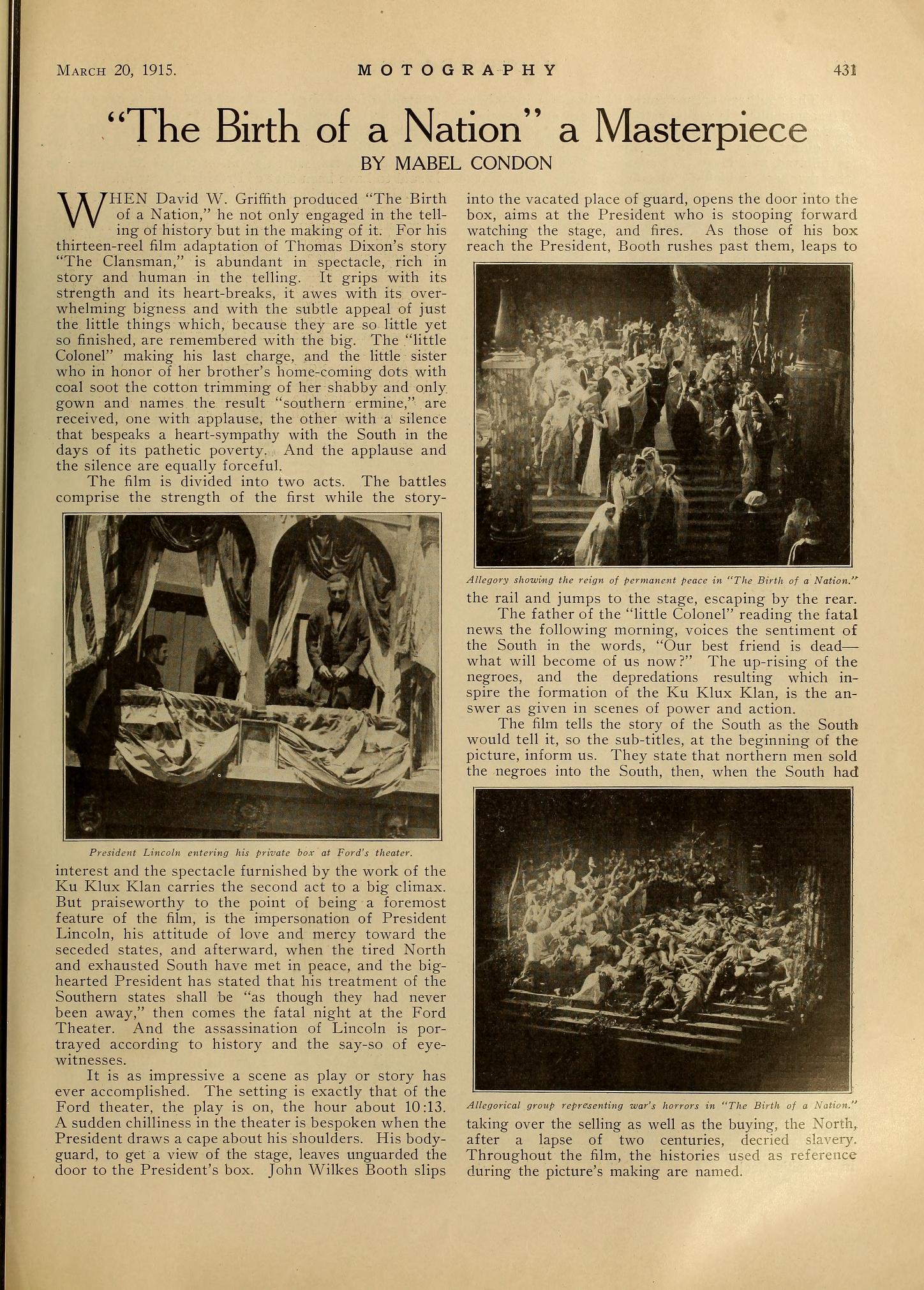
One hundred years after it was made The Birth of a Nation still has the power to both enthrall and appall. The film is as confounding as ever, both brilliant and repugnant. Groundbreaking in its use of innovative cinematic techniques, it remains tainted by its brazen racism.
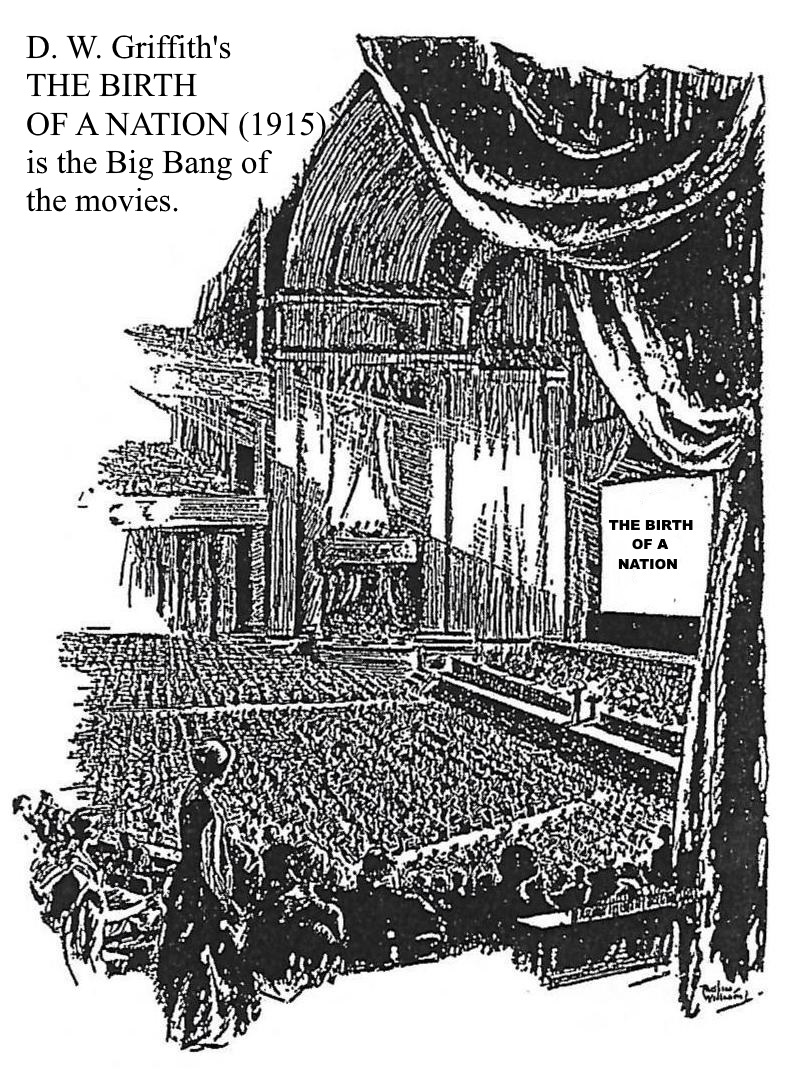
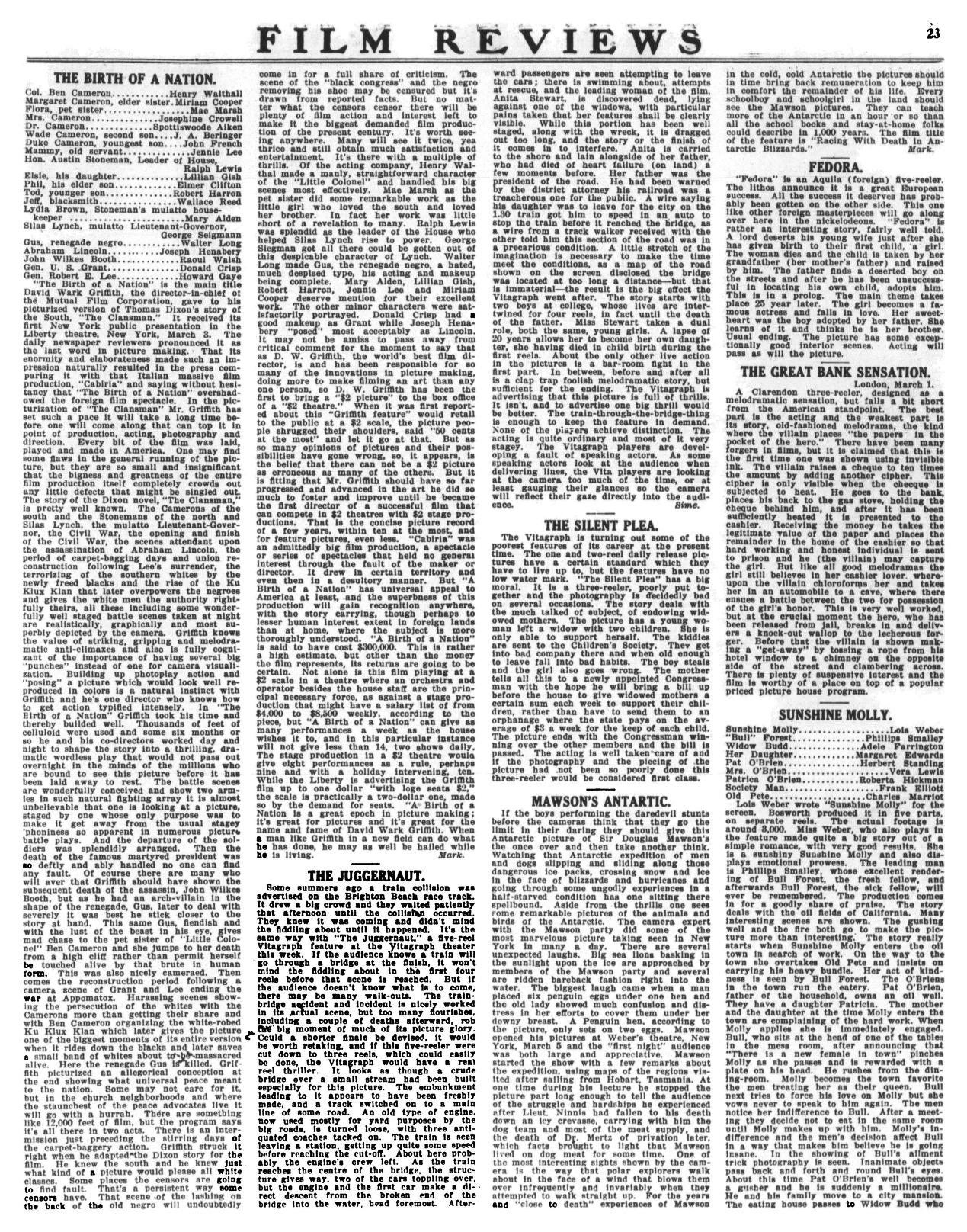
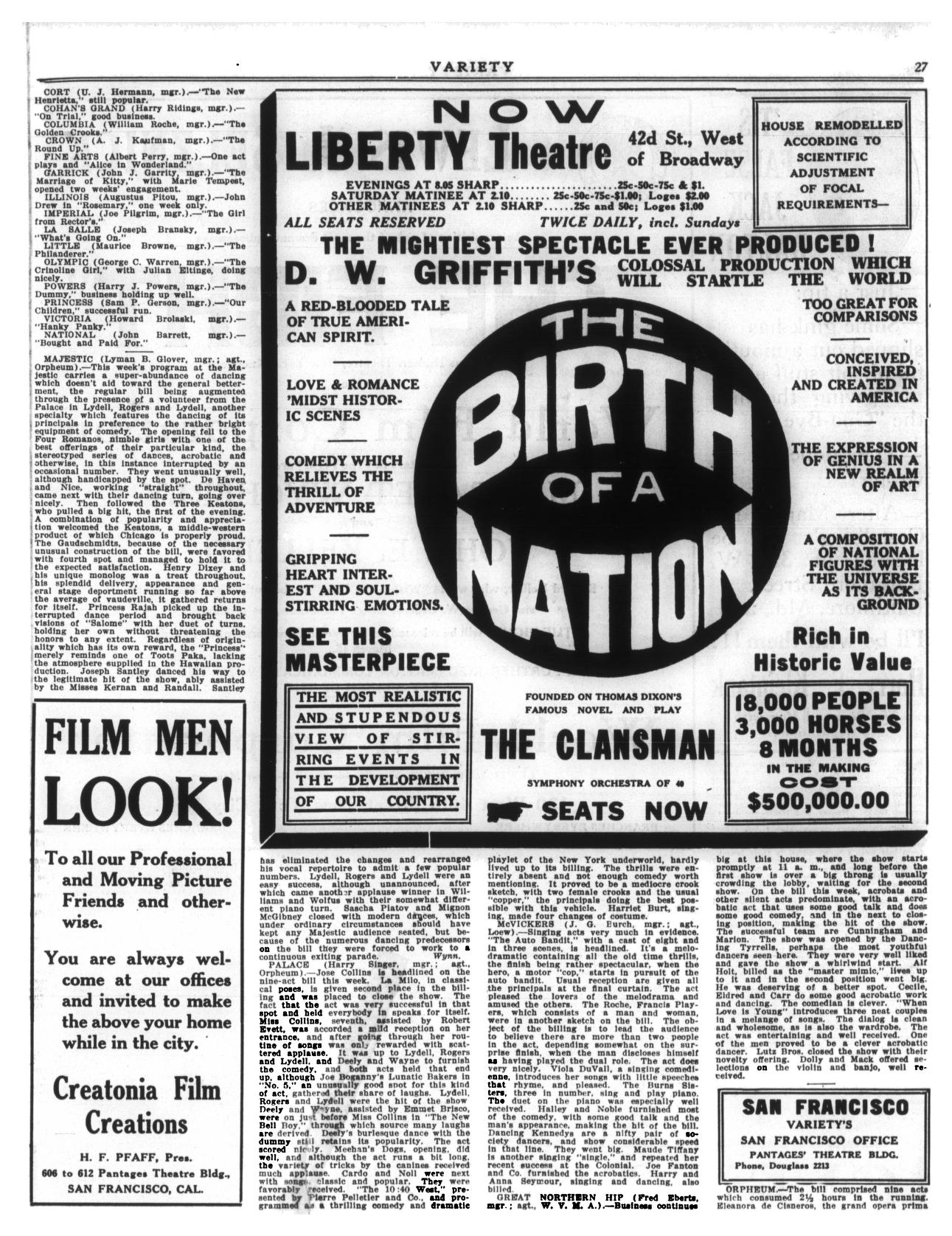
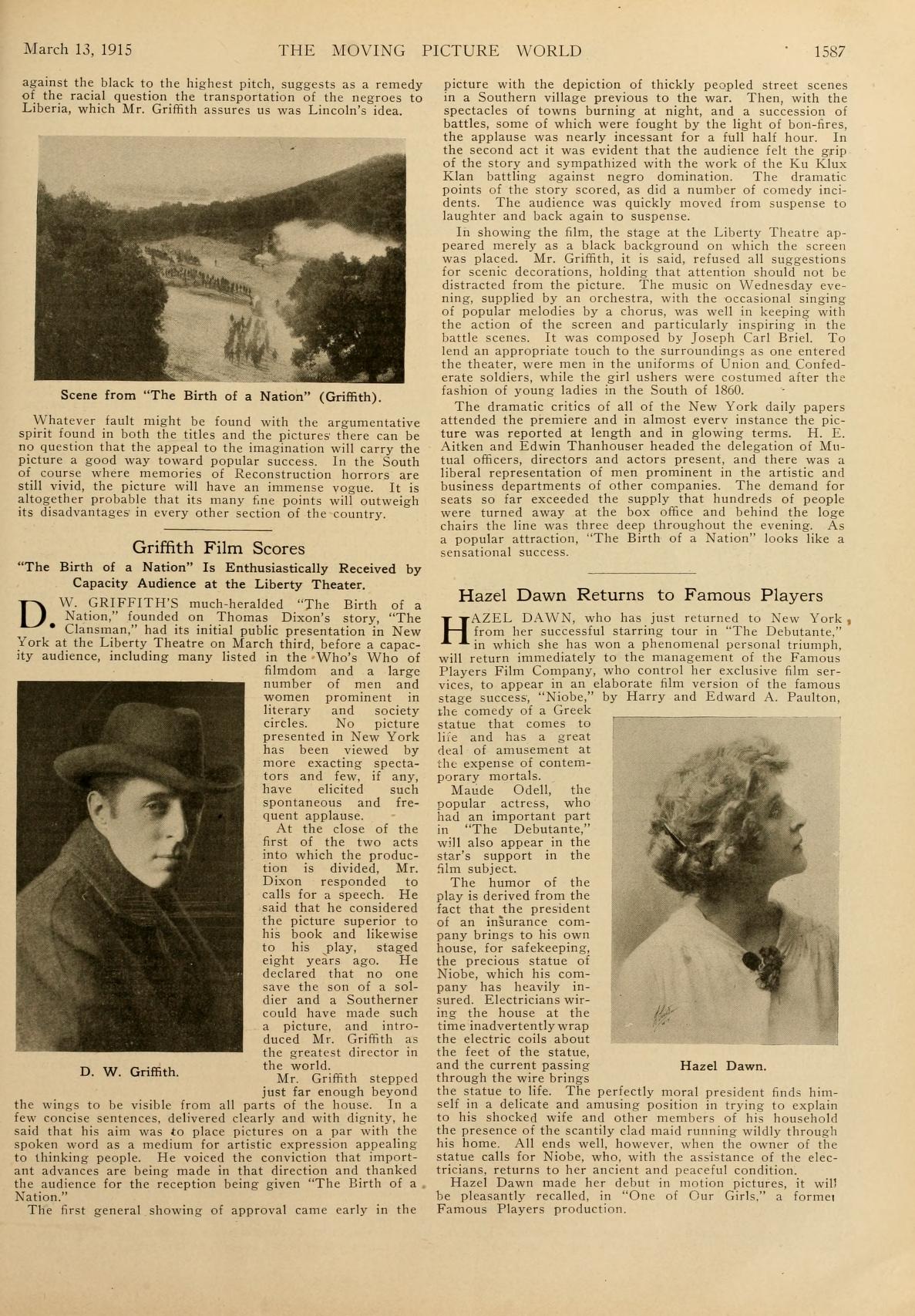
The Birth of a Nation was the creation of D. W. Griffith, who had tried his hand as an actor and playwright but whose real genius lay in film-making. Nothing on its scale had even been attempted before. It was the epic story of the relationship between two American families, one Union, the other Confederate, at the time of the Civil War and the Reconstruction that followed. The film ran for more than three hours and employed (according to a New York Times report from the time) 18,000 people and 3,000 horses. By 1922 it had been watched by more than five million people. It was the first blockbuster.
“It was a box office success – a mainstream film, so utterly mainstream,” says Professor Alan Rice, a Birth of a Nation expert at The Institute for Black Atlantic Research at the University of Central Lancashire, who has been organising a series of symposia on the film.
It made history by becoming the first film ever to be screened at the White House. But it was revolutionary for another reason: “It was very important in [that] it was the first full-scale long narrative using a lot of the new techniques of film-making,” says Rice.
Reg Hartt: THE BIRTH OF A NATION (1915) was not a mainstream film. To understand why the picture was mainstream we need to know what mainstream means.
-
- Production & Funding: Produced by large commercial studios or media conglomerates (such as Disney or major Hollywood entities) with multi-million-dollar budgets.
- Distribution & Marketing: Backed by massive global marketing campaigns, wide theatrical distribution, and cross-promotion (merchandise, fast-food tie-ins, trailers).
- Star Power: Features A-list, recognizable celebrity talent to drive ticket sales and public interest.
- Narrative & Style: Employs accessible storytelling, clear genre conventions (blockbusters, action, romantic comedies), and classical continuity editing designed to make the film easy for broad audiences to comprehend.
- Ideology: Frequently examined in media studies for how they reflect, normalize, or propagate dominant cultural, social, and political ideologies.
David Wark Griffith began making THE CLANSMAN (as THE BIRTH was then called) while employed by THE MUTUAL FILM COMPANY. After he had spent his allotted budget of $10,000.00 Mutual could see no way of recovering their investment at then current motion picture prices (5 cents, 10 cents, tops, 25 cents). They divorced themselves from the picture’s production.
Griffith created his picture independent of any studio. This is established fact.
STAR POWER: No one appearing in THE BIRTH had star power though, as a result of the picture, many, Lillian Gish, became stars. This is established fact. Professor Alan Rice is entirely wrong is his statement. A responsible journalists checks statements BEFORE posting them.
2. “But for all its magnificence, what is inescapable in any assessment of The Birth of a Nation is the troubling racism that leaps off the screen.“’The film is one of the most racist films ever made. Maybe the most racist film ever made,” says Ellen Scott, author of the just-published Cinema Civil Rights. “This film actually depicts lynching as a positive thing,” she says. “The politics of the film was essentially to say certain black people are worthy of being lynched. In that sense it’s extremely racist.’”
Reply: Racism is an outdated concept which we know to be false. Using it is using language we know to be incendiary. It is lynch mob language. IS THE PICTURE ANTI-NEGRO? No. September 4, 1948 James Agee: David Wark Griffith: (Today, The Birth of a Nation is boycotted or shown piecemeal; too many more or less well-meaning people still accuse Griffith of having made it an anti-Negro movie. At best, this is nonsense, and at worst, it is vicious nonsense. Even if it were an anti-Negro movie, a work of such quality should be shown, and shown whole. But the accusation is unjust. Griffith went to almost preposterous lengths to be fair to the Negroes as he understood them, and he understood them as a good type of Southerner does. I don’t entirely agree with him; nor can I be sure that the film wouldn’t cause trouble and misunderstanding, especially as advertised and exacerbated by contemporary abolitionists; but Griffith’s absolute desire to be fair, and understandable, is written all over the picture; so are degrees of understanding, honesty, and compassion far beyond the capacity of his accusers. So, of course, are the salient facts of the so-called Reconstruction years.)
Hiram Revels, the first Black Senator, wrote to President Grant:
Letter dated November 6, 1875.
“….Since reconstruction, the masses of my people have been, as it were, enslaved in mind by unprincipled adventurers, who, caring nothing for country, were willing to stoop to anything no matter how infamous, to secure power to themselves and perpetuate it. My people are naturally Republicans and always will be, but as they grow older in freedom so do they in wisdom. A great portion of them have learned that they were being used as mere tools, and, as in the late election, not being able to correct existing evils among themselves, they determined by casting their ballots against those unprincipled adventurers, to overthrow them…. My people have been told by these schemers, when men have been placed on the ticket who were notoriously corrupt and dishonest, that they must vote for them; that the salvation of the party depended upon it; that the man who scratched a ticket was not a Republican. This is only one of the many means these unprincipled demagogues have devised to perpetuate the intellectual bondage of my people. To defeat this policy, at the late election men, irrespective of race, color, or party affiliation, united, and voted together against men known to be incompetent and dishonest. I cannot recognize, nor do the mass of my people who read, recognize the majority of the officials who have been in power for the past two years as Republicans….
“The great mass of the white people have abandoned their hostility to the general government and Republican principles, and to-day accept as a fact that all men are born free and equal, and I believe are ready to guarantee to my people every right and privilege guaranteed to an American citizen. The bitterness and hate created by the late civil strife has, in my opinion, been obliterated in this state, except perhaps in some localities, and would have long since been obliterated in this state, were it not for some unprincipled men who would keep alive the bitterness of the past, and inculcate a hatred between the races, in order that they may aggrandize themselves by office, and its emoluments, to control my people, the effect of which is to degrade them. As an evidence that party lines in this state have been obliterated, men were supported without regard to their party affiliations, their birth, or their color, by those who heretofore have acted with the Democratic party, by this course giving an evidence of their sincerity that they have abandoned the political issues of the past, and were only desirous of inaugurating an honest state government, and restoring a mutual confidence between the races.; I give my opinion, that had our state adhered to Republican principles, and stood by the platform upon which it was elected, the state to-day would have been upon the highway of prosperity. Peace would have prevailed within her borders, and the Republican party would have embraced within her folds thousands of the best and purest citizens of which Mississippi can boast, and the election just passed would have been a Republican victory of not less than eighty to a hundred thousand majority; but the dishonest course which has been pursued has forced into silence and retirement nearly all of the leading Republicans who organized, and have heretofore led the party to victory. A few who have been bold enough to stand by Republican principles, and condemn dishonesty, corruption, and incompetency have been supported and elected by overwhelming majorities. If the state administration had adhered to Republican principles, advanced patriotic measures, appointed only honest and competent men to office, and sough to restore confidence between the races, bloodshed would have been unknown, peace would have prevailed, Federal interference been unthought of; harmony, friendship, and mutual confidence would have taken the place of the bayonet….”
Booker T. Washington, in UP FROM SLAVERY, wrote, “Naturally, most of our people who received some little education became teachers or preachers. While among these two classes there were many capable, earnest, godly men and women, still a large proportion took up teaching or preaching as an easy way to make a living. Many became teachers who could do little more than write their names. I remember there came into our neighbourhood one of this class, who was in search of a school to teach, and the question arose while he was there as to the shape of the earth and how he would teach the children concerning this subject. He explained his position in the matter by saying that he was prepared to teach that the earth was either flat or round, according to the preference of a majority of his patrons.” https://archive.org/details/upfromslaveryaut00wash_0/page/80/mode/2up .
Woodrow Wilson, in HISTORY OF THE AMERICAN PEOPLE Volume 5, confirms the view Griffith put on the screen: https://archive.org/details/historyofamerica05wils/page/n21/mode/2up .
Responsible journalists especially when dealing with sensitive material check their sources.
“McEwan sees the underlying story as deeply flawed. “The film argues that giving black people rights was a terrible, terrible error, that they did all sorts of horrible things that actually they didn’t do, and that the noble Ku Klux Klan (KKK) was this wonderful saviour that saved America,” he says. “It couldn’t be any more wrong.”
“The film is credited with reviving the racist KKK, who adopted it as a recruitment tool. “The Ku Klux Klan had been kind of a dead organisation by 1915, but when the film [came out and became a hit] the KKK was refounded, capitalised on [the film’s success] and in the 1920s became a massive organisation at the peak of nativist fervour in the United States,” says Paul McEwan.
Again, checking the above sources we learn Paul McEwan could not be more wrong. The attached from a Griffith scholar who has asked to remain anonymous (thank to the hysteria sober study of Griffith generates against those who engage in it)
” Sito begins by writing that The Birth of a Nation was “considered for many years the first American feature-length film” until the 1999 discovery of the 1912 production, Richard III. For the record, a print of the long-lost Richard III was discovered in 1996, a find that was widely reported at the time. As for his claim that up to that time The Birth was considered (by who?) the first American feature film, that is a statement so utterly bizarre as to defy comprehension, especially since Sito was a grown man of 40 involved with the motion picture industry since 1976 who should have known better. The Birth had been preceded by, among other American feature films, the early films of Cecil B. DeMille for Lasky in 1914; the features Mary Pickford made for Famous Players in 1913-14; Helen Gardner’s 1912 feature, Cleopatra; Selig’s celebrated feature of 1914, The Spoilers; Universal’s famed film about white slavery, Traffic in Souls (1913); Mack Sennett’s legendary feature-length comedy, Tillie’s Punctured Romance (1914); Sidney Drew’s gay-themed comedy for Vitagraph, A Florida Enchantment (1914); many works produced by Thomas Ince including the powerful feature, The Italian, filmed in 1914 and released on January 1, 1915; and Griffith’s own features preceding The Birth, Judith of Bethulia (1913), his final film for Biograph, and the four independent features he made for his own company released in 1914. No knowledgeable historian has ever claimed that The Birth of a Nation was the first American feature. What they did say–correctly–is that it was the longest and most spectacular American film up to that time. With no other American feature surfacing to dispute that claim, it is beyond belief why someone would feel obliged to bring up Richard III in an effort to diminish The Birth‘s actual standing. However, given Sito’s obvious bias against Griffith, accuracy is far from being his aim. Apparently, he feels that one way to relegate The Birth to the dustbin of history is to argue that its supposed reputation for innovation was undone by the discovery of Richard III in 1999 (sic), coincidentally (?) the year that Griffith’s name was stripped from the DGA’s Lifetime Achievement Award. That his sloppy approach also deletes the many other landmark American features is apparently of no concern to him.
Sito’s inaccuracies do not end with this. He states that Woodrow Wilson was, like Griffith and Dixon, the son of a Confederate soldier. In fact, Joseph Ruggles Wilson, the future president’s father, was a Presbyterian minister and while he was briefly a chaplain in the Confederate Army, he never served as a soldier. Indeed, given the state of health of his oldest son Woodrow and the closing of many schools due to the war raging in the South, the elder Wilson was responsible for his son’s education at home. Sito misquotes the famous statement about The Birth widely attributed to President Wilson (“like writing history with lightning”) as “history written with a thunderbolt.”
Sito then concludes his post by describing Griffith as a “drunken has-been” who while at Chasen’s Restaurant was reduced to begging MGM’s head of production, Dore Schary, for a job in Hollywood, an incident that he says inspired Billy Wilder to write Sunset Blvd. Schary only became vice-president of production in July 1948, a little over a week before Griffith’s passing on July 23. The incident to which Sito was referring supposedly occurred months earlier that year when a “stately but dissipated” Griffith angrily confronted Sam Goldwyn at Romanoff’s Restaurant where he was dining with his wife and Billy Wilder about the fact that he (Griffith) was no longer working in the industry. Whether this story is true or not (anecdotes of this kind related years after the fact can sometimes be exaggerated), it does not involve Dore Schary at all. In my book, Mr. Griffith’s House with Closed Shutters, I quoted from a 1948 article by Inez Wallace, a veteran columnist who had known Griffith for many years, in which she discussed the late director and a conversation she had with him in the Hollywood Knickerbocker Hotel a few nights before his death. She noted that they talked about Colonel William N. Selig who had recently died on July 16. The impression he then made on her was that of a serene individual not given to the kind of drunken outbursts such as has been reported from some months earlier. It would seem that his fiancee, the long-forgotten Madeline Frisina Haxby, may have exercised a stabilizing influence on him. I’m certain the only reason that Sito chose to recount a sordid anecdote about Griffith near the end of his life was to diminish his stature further.
“I’m heartily sick of this endless controversy and frankly would rather concentrate on other matters. Needless to say, Sito repeats the tired old claims that The Birth led to an increase in lynchings and the revival of the supposedly defunct KKK. Statistics do not support the argument that the release of the film in 1915 resulted in a dramatic increase in the rate of lynchings–in fact, 1917 saw a decline in the number of such crimes–and in all my years of researching this topic, I’ve yet to find a single instance of deadly racial violence directly related to showings of The Birth. As for the Klan, judging from the newspapers of the time there were a number of Klan revivals in the early 1910s well before the release of the film. As a matter of record, the first revival of the Klan on a nation-wide scale was during 1918 as a direct result of the anti-German hatred engendered by the US participation in World War I. With the outbreak of the influenza pandemic and the end of the war in late 1918, the Klan faded from view only to come roaring back to life in 1920 as a result of the Red Scare, the enactment of Prohibition and the targeting of immigrants by much of the establishment. And while the revived KKK undeniably liked The Birth, that affection scarcely extended to Griffith’s other films as their publications sharply attacked Orphans of the Storm and The White Rose. Undoubtedly, they would also have denounced Intolerance and Broken Blossoms had they been as active at the time those films were released as they were later. In any case, scapegoating a lone artist like Griffith for all of America’s many racial and social ills provides a convenient excuse for so-called pundits and experts to minimize the essential role of the political and news media forces in perpetuating these evils over generations.
“As Tom Sito was born in 1956 and was active in the motion picture industry in the animation field, his apparent ignorance of the basic facts of early American cinema and of Griffith is inexcusable. Beginning with the Museum of Modern Art’s Griffith retrospective in 1965 and their widely anticipated but not entirely successful reconstruction of the original version of Intolerance in 1989-90, there was a notable 25 year period of intense interest in and research of Griffith and his life and work. My first published book in 1986, a study of Intolerance, was part of this notable revival in the director’s native country. Sito, however, apparently was not affected by this rediscovery. Perhaps due to his preoccupation with animation, he has had only a superficial acquaintance with other aspects of cinema history. He seems to only be affected by the shocking decline in Griffith’s reputation that began in the early 1990s and has continued ever since. This is all too characteristic of the current generation of cineastes putting out blogs about the silent films they profess to love while heaping scorn on the artist who more than any other single individual inspired the golden age of silent cinema. Too young to remember the decades of the Griffith revival, they have brought back and intensified all the tiresome cliches about the director and his work that one thought would have ended with all the gains of appreciation of him from the years 1965 to 1990.
“The three years since the publication of my latest and possibly last book, my biography of Pearl White, have been a fallow time in my life. My research and writing career that began 48 years ago with the publication of my first articles seems to have come to an end. With my latest book having failed to capture widespread attention and further opportunities diminishing at one of the worst periods in recorded history, I have experienced a severe case of writer’s block. I certainly do not want to spend the rest of my life endlessly trying to defend Griffith from a hostile society that has condemned him most unjustly and selectively with no regard for the basic facts. What I have written you in this e-mail is of a private, confidential nature. I have not authorized you to post any of the above on the Internet. If, however, you would like to contact Tom Sito privately and directly and make him aware of the errors I’ve pointed out, that is another matter so long as my criticisms remain confidential. I actually have a fear that my work on Griffith may have resulted in my being blacklisted or “canceled” as they say today.
“Despite Griffith’s steep fall from grace in his own country, that is by no means his fate in more distant lands and cultures. The 150th anniversary of his birth last year, totally ignored here, was celebrated in Japan with a series of his films screened at the Bacchus Koenji Theatre in Tokyo presented by Ms. Akiko Sasaki, one of the leading benshi narrators of silent films in the Land of the Rising Sun. I have attached images of programmes from last summer announcing the screenings of Orphans of the Storm in which Ms. Sasaki was assisted by junior high school students and Paul Leni’s The Cat and the Canary.”
I don’t expect this post to do anything except ignite against myself the vituperation that always greets those who stand up to lynch mobs.
Today some find the picture’s ending with a risen Jesus and Paradise bizarre.
That speaks to their cultural illiteracy.–Reg Hartt