
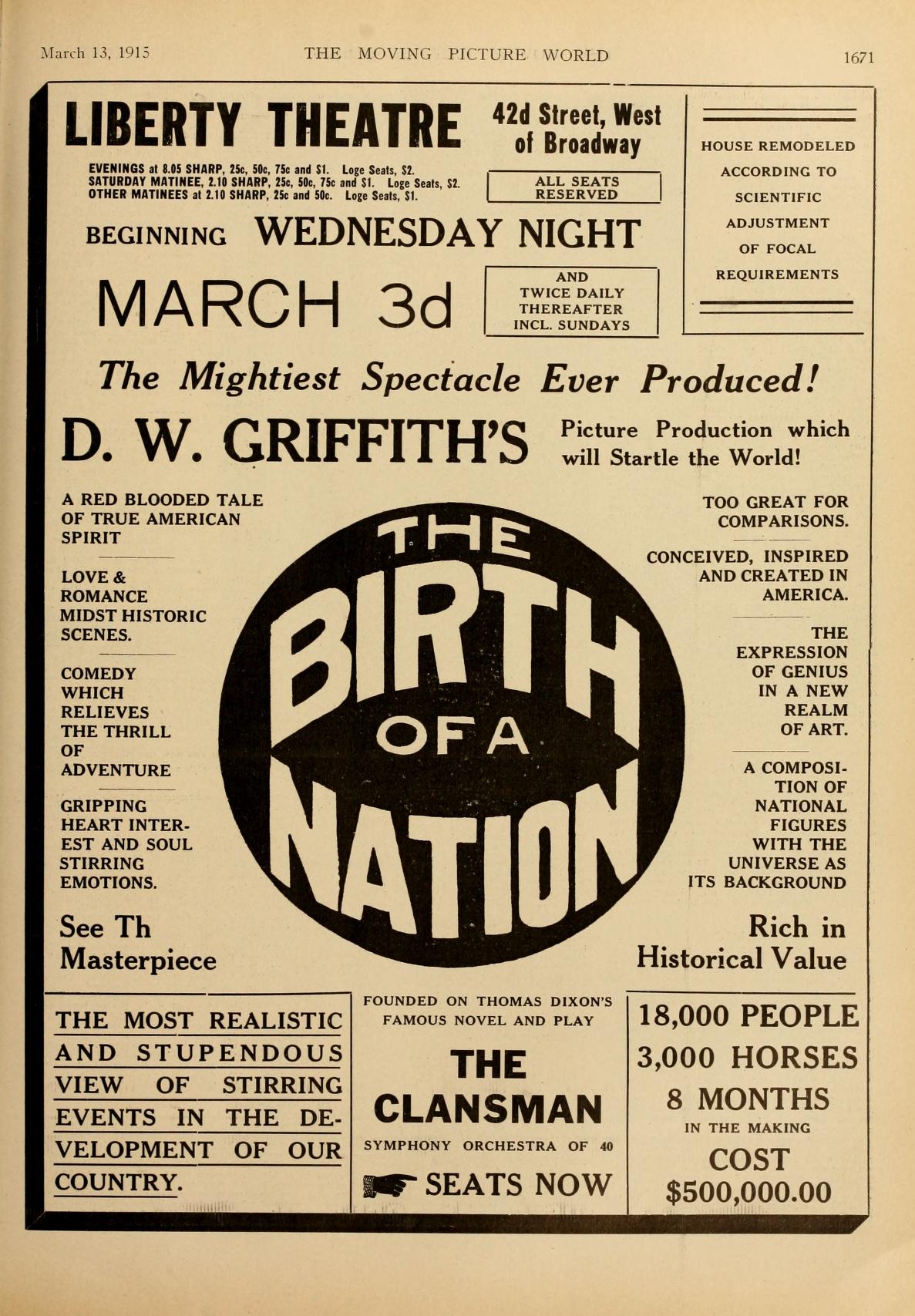
https://www.nitrateville.com/viewtopic.php?t=19597
Did BBC Journalist Tom Brook ( https://en.wikipedia.org/wiki/Tom_Brook ) choose to be willfully uninformed?
THE BIRTH OF A NATION (1915) is neither anti-Negro nor racist.
The number TWO reason THE BIRTH OF A NATION (1915) can not be called racist, nor can the film’s director nor anyone else is that we know from Science the idea of race itself is false.
The idea is unarguably false.
More than one has called the picture and its director evil. Neither THE BIRTH OF A NATION nor its director are evil.People do this are.
Griffith based on a novel and on the play based on that novel Both are works of fiction.
However he grounded his picture at a time when no one did in solid research. Thus when we see historical events happening in his picture Griffith provides the source from which he drew. When he stated the facts presented in his picture were true that is what he meant. Nor is it particularly difficult today for anyone to check his facts. Woodrew Wilson’s HISTORY OF THE AMERICAN PEOPLE can be viewed on line: https://archive.org/details/historyofamerica01wils_0 .
I have no reason to endorse The Ku Klux Klan. The revived Klan was against not only Negroes but also the Irish, The Italians, the Jews, Roman Catholics and many others. It was also anti-D. W, Griffith and several of his pictures. I am Irish (my dad’s side. He was Roman Catholic) and English (my mother’s side. She was Church of England). Those two had the backbone to stand up to their families. I have the backbone through them to stand up to ignorance. The est repository of ignorance it seems is in the halls of academia. As I am Irish Roman Catholic my ancestors are on the Klan’s hate list.
The first Black Senator, Hiram Revels, wrote a letter to President Grant which presents the situation as Griffith presents it: https://www.ncpedia.org/biography/revelsletter , Revels makes it clear corrupt whites were doing everything they could to exploit Negroes knowing the blame would bttached not to them but to those they used as puppets.Booker T. Washington, in his book, UP FROM SLAVERY, in the chapter on RECONSTRUCTION, states the same: https://archive.org/details/upfromslaveryaut00washuoft/page/80/mode/2up .
I am not writing to convince.
I am witnessing.
I am witnessing to the Lynch mob of which Tom Brook is a leader.
Will they listen?
They hardly ever do so the probable answer is no.
Too many have a vested interest in maintaining the lie of separate races.
My concern is not with Griffith and his picture alone. My concern is with all who get smeared with the inflammatory label “racist.”
There are no separate races.
There is one race. We are one family.
The Number One reason is that, as James Agee made clear, the film is not an attack on the Negro. THE BIRTH shows how freed Negroes were manipulated by corrupt Northerner white profiteers.
The details of this can be confirmed by consulting not only White sources (Woodrow Wilson’s History Of The American People: Reconstruction: https://archive.org/details/historyofamerica01wils_0 but also Black sources: Hiram Revels letter to Grant:https://www.ncpedia.org/biography/revelsletter , Booker T. Washington’s UP FROM SLAVERY https://archive.org/details/upfromslaveryaut00wash_0 ,
A common comment is that Griffith used caricatures of Blacks in his picture.
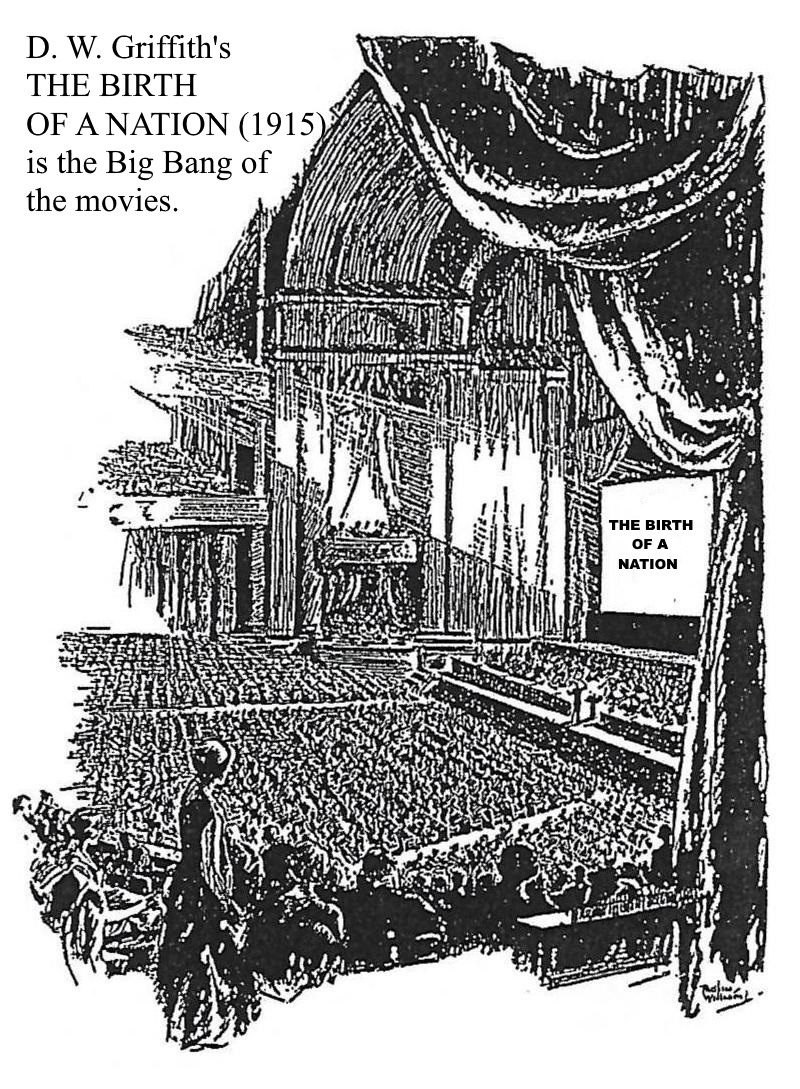
Caricatures are based on previous work. THE BIRTH OF A NATION (1915) is the big bang of the movies.
Another complaint is that Griffith used Blackface. Yes, he did. Black actors were allowed however they could not under the law touch white actors unless acting as servants. To make it absolutely clear to legal authorities Griffith used white actors clearly in Blackface. Informed writers know this.
In THE BIRTH OF A NATION (1915) Gus, played by Walter Long, the freed slave, has been told he can marry any woman he wants. He wants Flora (played by Mae Marsh). When he tells her he wants to marry her she has no knowledge of who he is. Take skin color out of it. Any woman young or old approached by a man she does not know who says, “I want to marry you,” is going to be met by fear and by refusal. What Gus does not understand is that while he has the right to marry any woman he wants she has the right to say, “No.”
Ultimately THE BIRTH OF A NATION (1915) is about the right to say, “No.”
David Wark Griffith handled the turbulent scenes (riots, rescues) as they are meant to be handled. Today everyone from Steven Spielberg, Spike Lee, Quentin Tarantino to you name it handles the same scenes the same way.
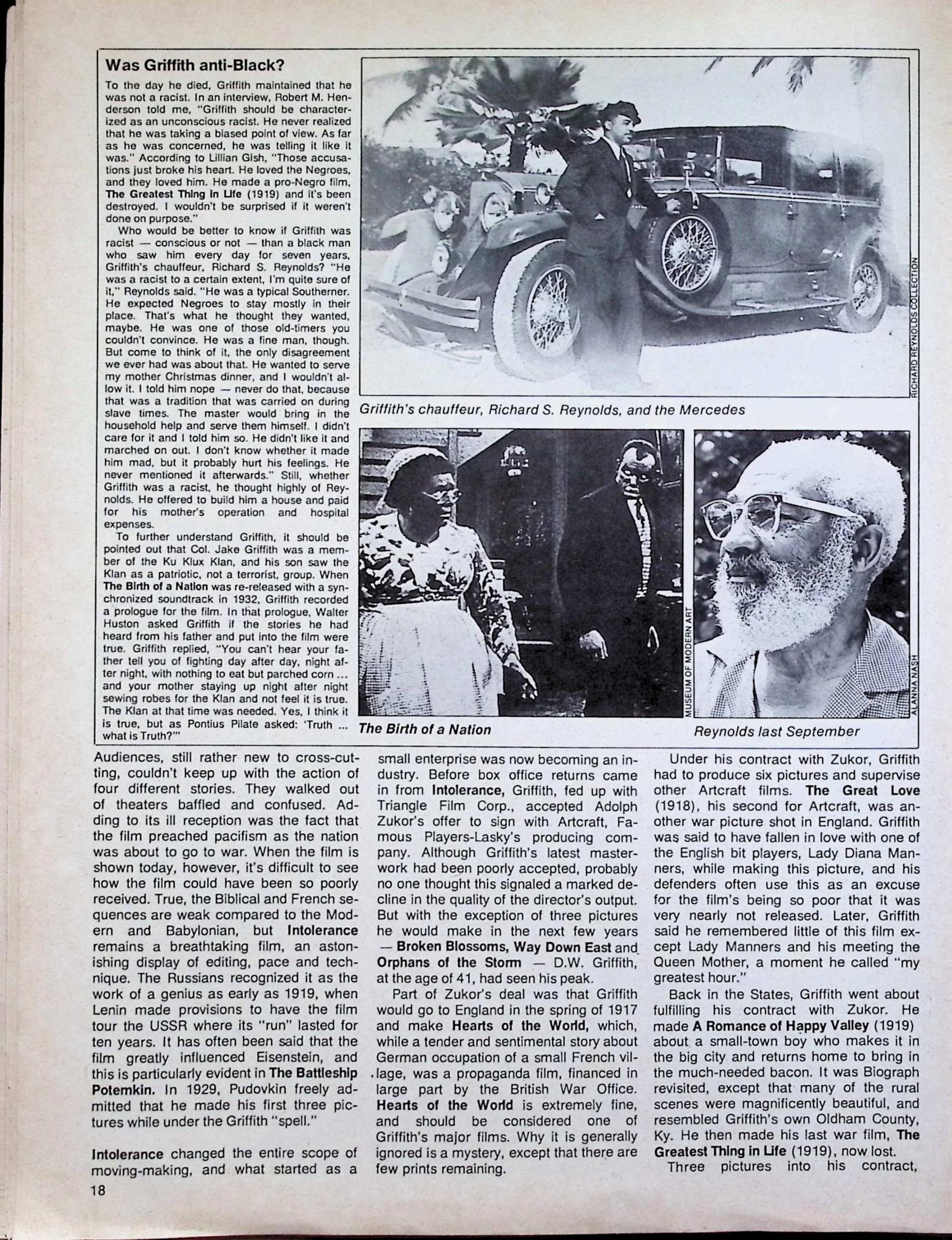
In a feature in the Canadian Film publication TAKE ONE ( https://archive.org/details/take-one-1973-09 ) asked id D. W. Griffith was a racist his Black chauffeur says, “Griffith was a paternal racist.”
Paternal means fatherly. Griffith was fatherly to everyone regardless of skin shade.
David Wark Griffith is the father of the cinema.
He more than deserves the respect he is not being given.
He is getting that respect from me.
As for THE KU KLUX KLAN, the Clan in Griffith’s picture is not the Klan that rose in its wake. Was Griffith responsible for the revived Klan? Was Stanley Kubrick responsible for the people who beat homeless men to death in the wake of CLOCKWORK ORANGE? The answer to both questions is no.
When people are unable to get help from the people in authority we have always turned to the only path available whether that was Robin Hood and his outlaws in the days of King John, Don Corleone in the days of THE GODFATHER or Nelson Mandela.
THE BIRTH OF A NATION (1915) accurately reflects the prevailing view of the day, THE DUNNING SCHOOL OF THOUGHT:
- Justification for White Supremacy: They viewed violent white Southern resistance, the rise of the Ku Klux Klan, and the eventual implementation of Jim Crow segregation and disenfranchisement not as civil rights violations, but as a necessary and “inevitable” restoration of order and civilized governance. [1, 2, 3]
Interestingly enough that is my Irish ancestors were also viewed as were Italians. As for the Jews, well their treatment was beyond contempt.
Times have changed for the better. David Wark Griffith saw the motion picture as a literal light burning in the dark with the power to dispel ignorance.
His pictures speak to his conviction. In essence his best pictures, including THE BIRTH OF A NATION (1915) are sermons.
Originally Griffith was to receive 48% of profits from THE BIRTH. He received 22% and signed away his rights to the picture after receiving it. He got $1 million which he put into his next picture, INTOLERANCE.
This is why he was unable to prevent THE BIRTH (originally 315 minutes) from being re-issued in a severely cut down sound 100 minute version which by the 1970s had had the prologues removed and was closer to 80 minutes.
In the prologues to that version he stated, “THE KLAN WAS NEEDED THEN.” By implication he stated the Klan was not needed now.
Speaking to Barnet Braverman in 1941 Griffith stated, “If THE BIRTH OF A NATION were done again it would have to be much clearer. Although the picture was made with no intention of embarrassing the Negro, as it stands today , it should not be shown to general; audiences. The Negro race has had enough of its share of trouble, more than enough of its share of injustice, oppression, tragedy, suffering and sorrow. And because of the social progress the Negroes have achieved in the face of these handicaps, it is best that THE BIRTH OF A NATION in its present form be withheld from public exhibition.–Page 8, Fred Silva, FOCUS ON THE BIRTH OF A NATION.
To my mind, is not to his detractors, David Wark Griffith clearly is a much better human being than his detractors like to present. Not only that he is a much better human being than all of them as one.
–Reg Hartt 30-09-2026.
September 4, 1948
James Agee David Wark Griffith
HE ACHIEVED what no other known man has ever achieved. To watch his work is like being witness to the beginning of melody, or the first conscious use of the lever or the wheel; the emergence, coordination, and first eloquence of language; the birth of an art: and to realize that this is all the work of one man.
We will never realize how good he really was until we have the chance to see his work as often as it deserves to be seen, to examine and enjoy it in detail as exact as his achievement. But even relying, as we mainly have to, on years-old memories, a good deal becomes clear.
One crude but unquestionable indication of his greatness was his power to create permanent images. All through his work there are images which are as impossible to forget, once you have seen them, as some of the grandest and simplest passages in music or poetry.
The most beautiful single shot I have seen in any movie is the battle charge in The Birth of a Nation. I have heard it praised for its realism, and that is deserved; but it is also far beyond realism. It seems to me to be a perfect realization of a collective dream of what the Civil War was like, as veterans might remember it fifty years later, or as children, fifty years later, might imagine it. I have had several clear mental images of that war, from almost as early as I can remember, and I didn’t have the luck to see The Birth of a Nation until I was in my early twenties; but when I saw that charge, it was merely the clarification, and corroboration, of one of those visions, and took its place among them immediately without seeming to be of a different kind or order. It is the perfection that I know of, of the tragic glory that is possible, or used to be possible, in war; or in war as the best in the spirit imagines or remembers it.
This is, I realize, mainly subjective; but it suggests to me the clearest and deepest aspect of Griffith’s genius: he was a great primitive poet, a man capable, as only great and primitive artists can be, of intuitively perceiving and perfecting the tremendous magical images that underlie the memory and imagination of entire peoples. If he had achieved this only once, and only for me, I could not feel that he was what I believe he is; but he created many such images, and I suspect that many people besides me have recognized them, on that deepest level that art can draw on, reach, and serve. There are many others in that one film: the homecoming of the defeated hero; the ride of the Clansmen; the rapist and his victim among the dark leaves; a glimpse of a war hospital; dead young soldiers after battle; the dark, slow movement of the Union Army away from the camera, along a valley which is quartered strongly between hill- shadow and sunlight; all these and still others have a dreamlike absoluteness which, indeed, cradles and suffuses the whole film.
This was the one time in movie history that a man of great ability worked freely, in an unspoiled medium, for an unspoiled audience, on a majestic theme which involved all that he was; and brought to it, besides his abilities as an inventor and artist, absolute passion, pity, courage, and honesty. The Birth of a Nation is equal with Brady’s photographs, Lincoln’s speeches, Whitman’s war poems; for all its imperfections and absurdities it is equal, in fact, to the best work that has been done in this country. And among moving pictures it is alone, not necessarily as “the greatest”—whatever that means—but as the one great epic, tragic film.
(Today, The Birth of a Nation is boycotted or shown piecemeal; too many more or less well-meaning people still accuse Griffith of having made it an anti-Negro movie. At best, this is nonsense, and at worst, it is vicious nonsense. Even if it were an anti-Negro movie, a work of such quality should be shown, and shown whole. But the accusation is unjust. Griffith went to almost preposterous lengths to be fair to the Negroes as he understood them, and he understood them as a good type of Southerner does. I don’t entirely agree with him; nor can I be sure that the film wouldn’t cause trouble and misunderstanding, especially as advertised and exacerbated by contemporary abolitionists; but Griffith’s absolute desire to be fair, and understandable, is written all over the picture; so are degrees of understanding, honesty, and compassion far beyond the capacity of his accusers. So, of course, are the salient facts of the so-called Reconstruction years.)
Griffith never managed to equal The Birth of a Nation again, nor was he ever to strike off, in any other film, so many of those final images. Nevertheless, he found many: the strikers in Intolerance—the realism of those short scenes has never been surpassed, nor their shock and restiveness as an image of near-revolution; the intercutting, at the climax of that picture, between the climaxes of four parallel stories, like the swinging together of tremendous gongs; the paralyzing excitement of the melodrama near the waterfall, in Way Down East; Paul Revere’s ride and the battle of Bunker Hill, in America; Danton’s ride, in Orphans of the Storm; most subtle and remarkable of all, the early morning scene in his German film, Isn’t Life Wonderful?, in which the ape-like Dick Sutherland pursues Carol Dempster through a grove of slender trees. All these images, and so many others of Griffith’s, have a sort of crude sublimity which nobody else in movies has managed to achieve; this last one, like his images of our Civil War, seems to come out of the deep subconscious: it is an absolute and prophetic image of a nation and a people. I will always regret having missed Abraham Lincoln, his last film to be released: a friend has told me of its wonderful opening in stormy mid-winter night woods, the camera bearing along toward the natal cabin; and that surely must have been one of Griffith’s finest images.
Even in Griffith’s best work there is enough that is poor, or foolish, or merely old-fashioned, so that one has to understand, if by no means forgive, those who laugh indiscriminately at his good work and his bad. (With all that “understanding,” I look forward to killing, some day, some specially happy giggler at the exquisite scene in which the veteran comes home, in The Birth of a Nation.) But even his poorest work was never just bad. Whatever may be wrong with it, there is in every instant, so well as I can remember, the unique purity and vitality of birth or of a creature just born and first exerting its unprecedented, incredible strength; and there are, besides, Griffith’s overwhelming innocence and magnanimity of spirit; his moral and poetic earnestness; his joy in his work; and his splendid intuitiveness, directness, common sense, daring, and skill as an inventor and as an artist. Aside from his talent or genius as an inventor and artist, he was all heart; and ruinous as his excesses sometimes were in that respect, they were inseparable from his virtues, and small beside them. He was remarkably good, as a rule, in the whole middle range of feeling, but he was at his best just short of his excesses, and he tended in general to work out toward the dangerous edge. He was capable of realism that has never been beaten and he might, if he had been able to appreciate his powers as a realist, have found therein his growth and salvation. But he seems to have been a realist only by accident, hit-and-run; essentially, he was a poet. He doesn’t appear ever to have realized one of the richest promises that movies hold, as the perfect medium for realism raised to the level of high poetry; nor, oddly enough, was he much of a dramatic poet. But in epic and lyrical and narrative visual poetry, I can think of nobody who has surpassed him, and of few to compare with him. And as a primitive tribal poet, combining something of the bard and the seer, he is beyond even Dovzhenko, and no others of their kind have worked in movies.
What he had above all, his ability as a craftsman and artist, would be hard enough—and quite unnecessary—to write of, if we had typical scenes before us, or within recent memory; since we have seen so little of his work in so many years, it is virtually impossible. I can remember very vividly his general spirit and manner—heroic, impetuous, tender, magniloquent, naive, beyond the endowment or daring of anybody since; just as vividly, I can remember the total impression of various major sequences. By my remembrance, his images were nearly always a little larger and wilder than life. The frame was always full, spontaneous, and lively. He knew wonderfully well how to contrast and combine different intensities throughout an immense range of emotion, movement, shadow, and light. Much of the liveliness was not intrinsic to the characters on the screen or their predicament, but was his own vitality and emotion; and much of it— notably in the amazing flickering and vivacity of his women—came of his almost maniacal realization of the importance of expressive movement.
It seems to me entirely reasonable to infer, from the extraordinary power and endurance in the memory of certain scenes in their total effect, that he was as brilliant a master of design and cutting and form as he was a composer of frames and a director of feeling and motion. But I cannot clearly remember one sequence or scene, shot by shot and rhythm by rhythm. I suspect, for instance, that analysis would show that the climactic sequence on the icy river, in Way Down East, is as finely constructed a piece of melodramatic story-telling as any in movies. But I can only venture to bet on this and to suggest that that sequence, like a hundred others of Griffith’s, is eminently worth analysis.
My veneration for Griffith’s achievements is all the deeper when I realize what handicaps he worked against, how limited a man he was. He had no remarkable power of intellect, or delicateness of soul; no subtlety; little restraint; little if any “taste,” whether to help his work or harm it; Lord knows (and be thanked) no cleverness; no fundamental capacity, once he had achieved his first astonishing development, for change or growth. He wasn’t particularly observant of people; nor do his movies suggest that he understood them at all deeply. He had noble powers of imagination, but little of the intricacy of imagination that most good poets also have. His sense of comedy was pathetically crude and numb. He had an exorbitant appetite for violence, for cruelty, and for the Siamese twin of cruelty, a kind of obsessive tenderness which at its worst was all but nauseating. Much as he invented, his work was saturated in the style, the mannerisms, and the underlying assumptions and attitudes of the nineteenth century provincial theater; and although much of that was much better than most of us realize, and any amount better than most of the styles and non-styles we accept and praise, much of it was cheap and false, and all of it, good and bad, was dying when Griffith gave it a new lease on life, and in spite of that new lease, died soon after, and took him down with it. I doubt that Griffith ever clearly knew the good from the bad in this theatricality; or, for that matter, clearly understood what was original in his work, and capable of almost unimaginably great development; and what was over-derivative, essentially non-cinematic, and dying. In any case, he did not manage to outgrow, or sufficiently to transform, enough in his style that was bad, or merely obsolescent.
If what I hear is right about the opening scene in Abraham Lincoln, this incapacity for radical change may have slowed him up but never killed him as an artist; in his no longer fashionable way, he remained capable, and inspired. He was merely unadaptable and unemployable, like an old, sore, ardent individualist among contemporary progressives. Hollywood and, to a great extent, movies in general, grew down from him rather than up past him; audiences, and the whole eye and feeling of the world, have suffered the same degeneration; he didn’t have it in him to be amenable, even if he’d tried; and that was the end of him. Or quite possibly he was finished, as smaller men are not, as soon as he had reached the limit of his own powers of innovation, and began to realize he was only repeating himself. Certainly, anyhow, he was natural-born for the years of adventure and discovery, not for the inevitable following era of safe-playing and of fat consolidation of others’ gains.
His last movie, which was never even released, was made fourteen or fifteen years ago; and for years before that, most people had thought of him as a has-been. Nobody would hire him; he had nothing to do. He lived too long, and that is one of few things that are sadder than dying too soon.
There is not a man working in movies, or a man who cares for them, who does not owe Griffith more than he owes anybody else.
“(Agee) was superbly intelligent, informed, sensitive, witty; and he could write like an angel. He was the best movie critic this country ever had.”–Arthur Knight, Saturday Review.
“What he says is of such profound interest, expressed with such extraordinary wit and felicity…that his articles belong in that very select class–the music critiques of Berlioz and Shaw are the only other members I know–of newspaper work which has permanent literary value.”–W. H. Auden.
https://en.wikipedia.org/wiki/James_Agee
++
I am certain his mother would have loved the turkey. Who would not. Paternal means fatherly. Griifitth, the father of the cinema, was fatherly with everyone under his age. He was fatherly with Lillian Gish whose career, along with that of many others, he fathered.
- Post-World War II (1950s): Following the atrocities justified by Nazi “race science” in the 1930s and 1940s, physical anthropologists and geneticists began actively dismantling the biological concept of race. UNESCO issued seminal statements in 1950 and 1951 declaring that race is a social myth rather than a biological reality. [1, 2]
- Richard Lewontin’s Study (1972): Harvard evolutionary biologist Richard Lewontin analyzed global genetic data and proved that roughly 85% to 94% of human genetic variation occurs within local populations, and only a tiny fraction (about 6%) accounts for differences between traditional racial groups. [1]
- Modern Scientific Statements: Major organizations—including the American Association of Biological Anthropologists and the American Society of Human Genetics—have explicitly stated that race is a socio-political construct rather than a biological one. [1, 2]
-
Duke UniversityDoes Race Exist?Does Race Exist? Royal be asking me this question? Because I was wrong. In a landmark paper based on the Human Genome Project, sci…

-
Cambridge University Press & AssessmentRace Isn’t Biological — So Why Do So Many Still Think It Is?Race Isn’t Biological — So Why Do So Many Still Think It Is? Kevin Lala and Kalyani Twyman 29 August 2025 Last update: 29/08/25 14…

-
SAPIENS – Anthropology MagazineRace Is Real, But It’s Not GeneticRace Is Real, But It’s Not Genetic In 1972, Harvard evolutionary biologist Richard Lewontin had the idea to test how much human ge…


« Olivia Chow has given me no reason to support her. Here is the reason why I do. Our school systems are factories for the willfully uninformed. »