
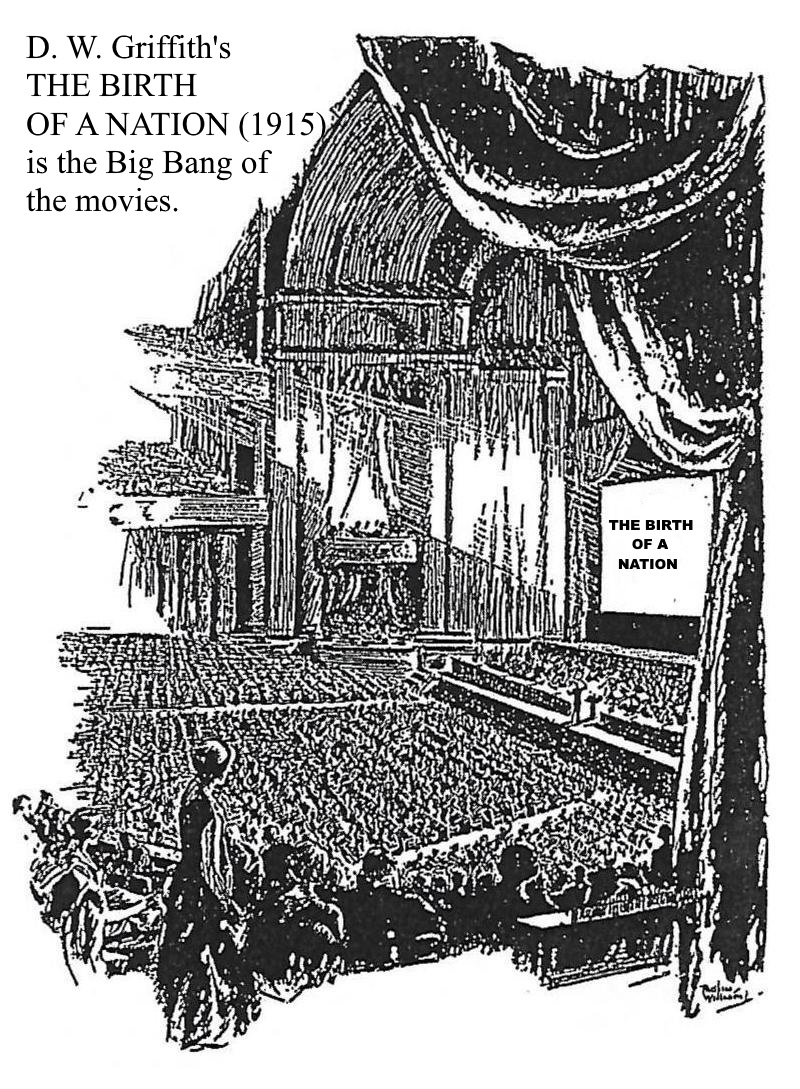
The Comparison: Scientific Concept vs. Social Animus
While the webpage uses a strict biological definition to reject the label, mainstream film historians and sociologists evaluate the movie based on its social animus and real-world impact.
| Perspective | Main Argument regarding The Birth of a Nation | ||||||
| The Biological/Semantic Argument (from your text) | It cannot be racist because race is an illusion. Because science proves there is only one human race, applying the inflammatory label “racist” to a filmmaker who was trying to depict history as he researched it is an inaccurate, emotional smear. | ||||||
| The Sociological/Historical Argument (Mainstream View) | It is racist because it promotes white supremacy.
The Comparison: Scientific Concept vs. Social Animus While the webpage uses a strict biological definition to reject the label, mainstream film historians and sociologists evaluate the movie based on its social animus and real-world impact.
Summary If you define “racism” strictly as a belief system requiring the actual existence of separate biological entities, then the article argues the term is invalid. However, if you define “racism” as prejudice, discrimination, or antagonism directed against someone of a different ethnicity based on the belief that certain groups are superior, then the film remains a textbook definition of the word for most historians. Would you like to explore more about how the social construct of race evolved despite lacking a biological basis, or look closer at the historical documents (like the Hiram Revels letter) mentioned in the article? |
Summary
If you define “racism” strictly as a belief system requiring the actual existence of separate biological entities, then the article argues the term is invalid. However, if you define “racism” as prejudice, discrimination, or antagonism directed against someone of a different ethnicity based on the belief that certain groups are superior, then the film remains a textbook definition of the word for most historians.
Would you like to explore more about how the social construct of race evolved despite lacking a biological basis, or look closer at the historical documents (like the Hiram Revels letter) mentioned in the article?
Let us take a look at this:
THE BIRTH is racist because it promotes white supremacy. No. THE BIRTH OF A NATION (1915) accurately reflects ideas which were old when Rome was young. The idea of supremacy based on skin shade is not limited to people with white skins. In all cultures the ruling class has seen itself superior to those below it. Inevitably, as with ROME the ruling class by limiting its birth rate because large families are viewed as animalistic the ruling class breeds itself out of existence at which point the class below them move up. The oppressed become yet another oppressor. They too breed themselves out of existence. Ideas of “racial purity” are inherently false. By limiting breeding to “pure” stock only that which saw itself as superior swiftly becomes genetically unstable.
“Even though biological race is a myth, the social construct of race is used to oppress people.” No. The oppressed people in THE BIRTH OF A NATION (1915) are the White Southerners .
“The film used vicious caricatures.” No. Caricatures evolve from previous work. There was nothing before THE BIRTH OF A NATION (1915) to draw caricatures from.
“vilified Black people.” No. Continually throughout his picture Griffith makes it clear that even the film’s most extreme character, Silas Lynch, has been deliberately misled. He is not responsible for his actions. James Agee states Griffith went out of his way to be fair. He did.
“glorified a white supremacist terrorist group (the KKK), which directly caused real-world violence and systemic harm.” No. There is no difference between The KKK in THE BIRTH OF A NATION (1915) Nelson Mandela and those he led in South Africa, the legendary Robin Hood and his outlaws against King John and groups like the Italian MAFIA (MY FAMILY), the Irish and the Jewish gangsters who rose up precisely because the forces that should have protected them refused to. Critics and writers viewing Francis For Coppola’s GODFATHER films seem not to realize Don Corleone becomes the Protector because his people are denied protection. Don Corleone and his son Michael are the only truly moral men in the story. Everyone else can be bought including those in the highest office.
In his spoken word prologue to the sound re-issue of THE BIRTH OF A NATION (1915) Griffith states “The Klan was needed then.” His statement separates the KLAN in his picture completely from the one which rose up after.
Stanley Kubrick could not imagine anyone viewing CLOCKWORK ORANGE (1971) would mirror moments in his picture and kill old homeless men living on the street,
The revived KLAN was not only anti-Negro it was anti-Roman Catholic, anti-Irish (the O’Hara family–the heroes–in GONE WITH THE WIND (1939) is Irish), Italians, the Jews. As Irish and Roman Catholic by birth I had to understand these issues BEFORE I could publicly present the picture. I present many controversial motion pictures. I am recognized for presenting them in a manner that inoculates viewers. While many have chosen to see myself and my presentations as a threat they are not. They are endorsed by strong voices. Stronger can’t be found:
JULIA SCUTARU, retired journalist, Bucharest, Romania: “In Toronto, I discovered by chance, CineForum. Pure chance but a fortunate one. In that small room exhaling culture, passion and dedication, I watched the movie TRIUMPH OF THE WILL, an important historical, political and social document., and real artistic achievement….As a journalist (in Romania) I worked in the cultural field, including film reviews. Therefore I came to the CineForum not just as a movie lover, but as a knowledgeable professional…We live in an era authoritatively dominated by brainwashing and political correctness…I admired Reg Hartt’s courage and passion put in searching out and defending the human truth, the artistic truth, the historical truth; the Truth and unveiling it…Discovering Reg Hartt and his CineForum was one of the most important events of my visit in Toronto.”
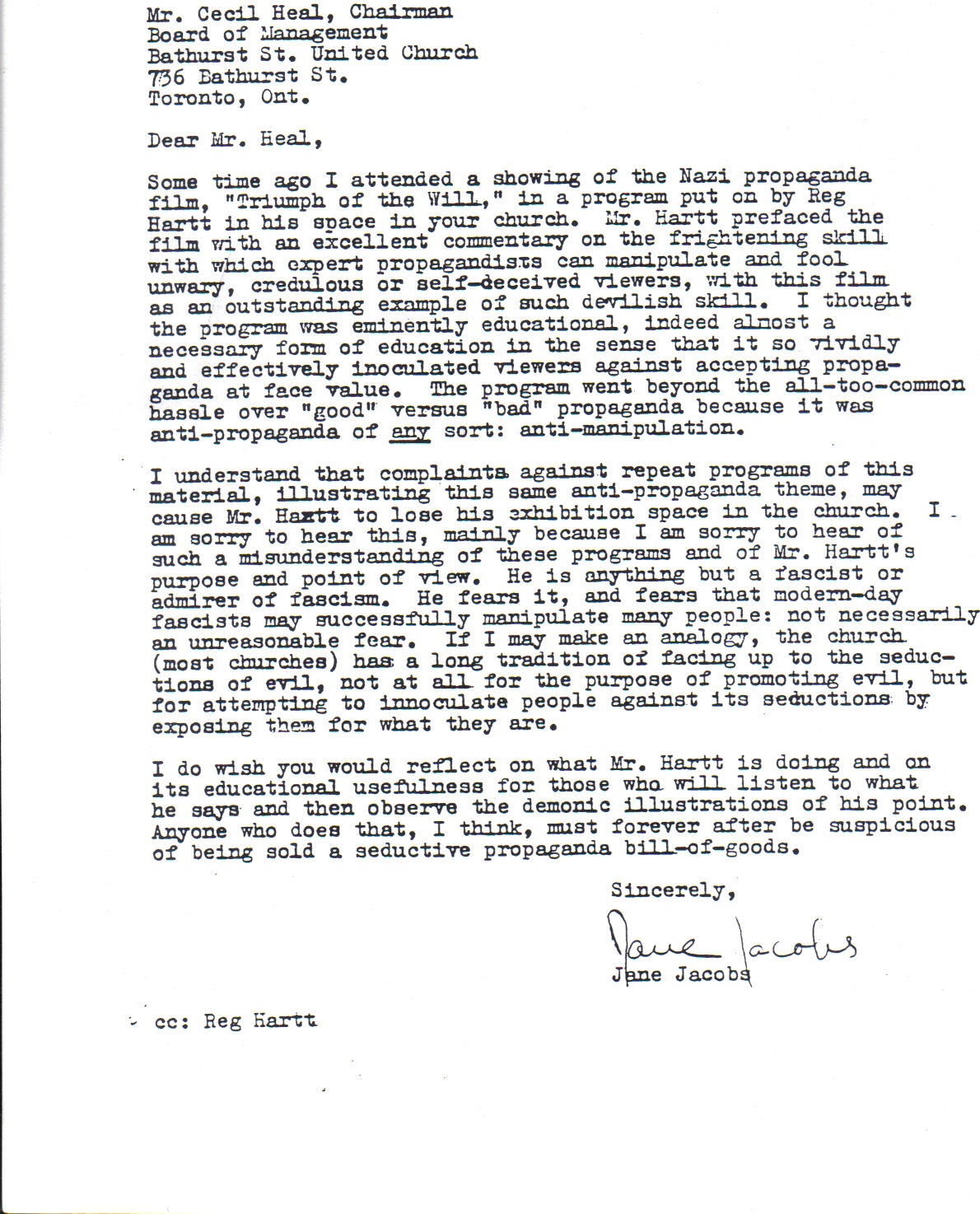
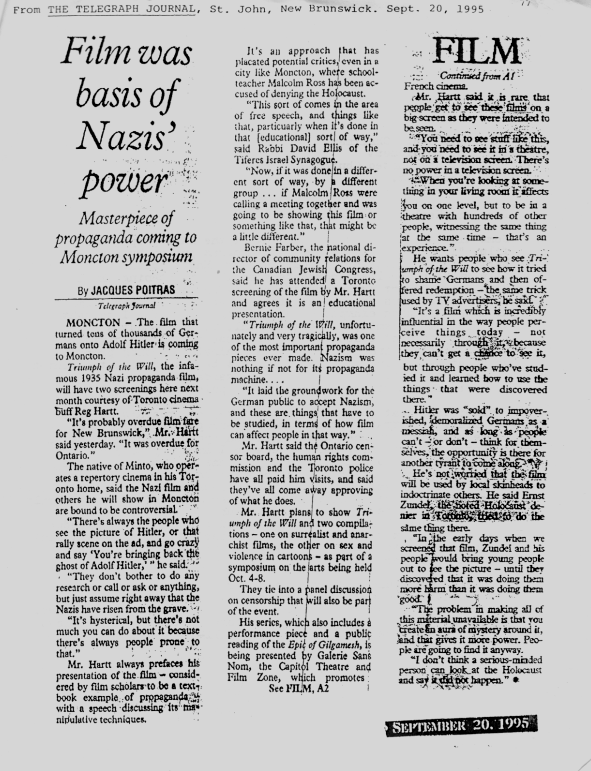
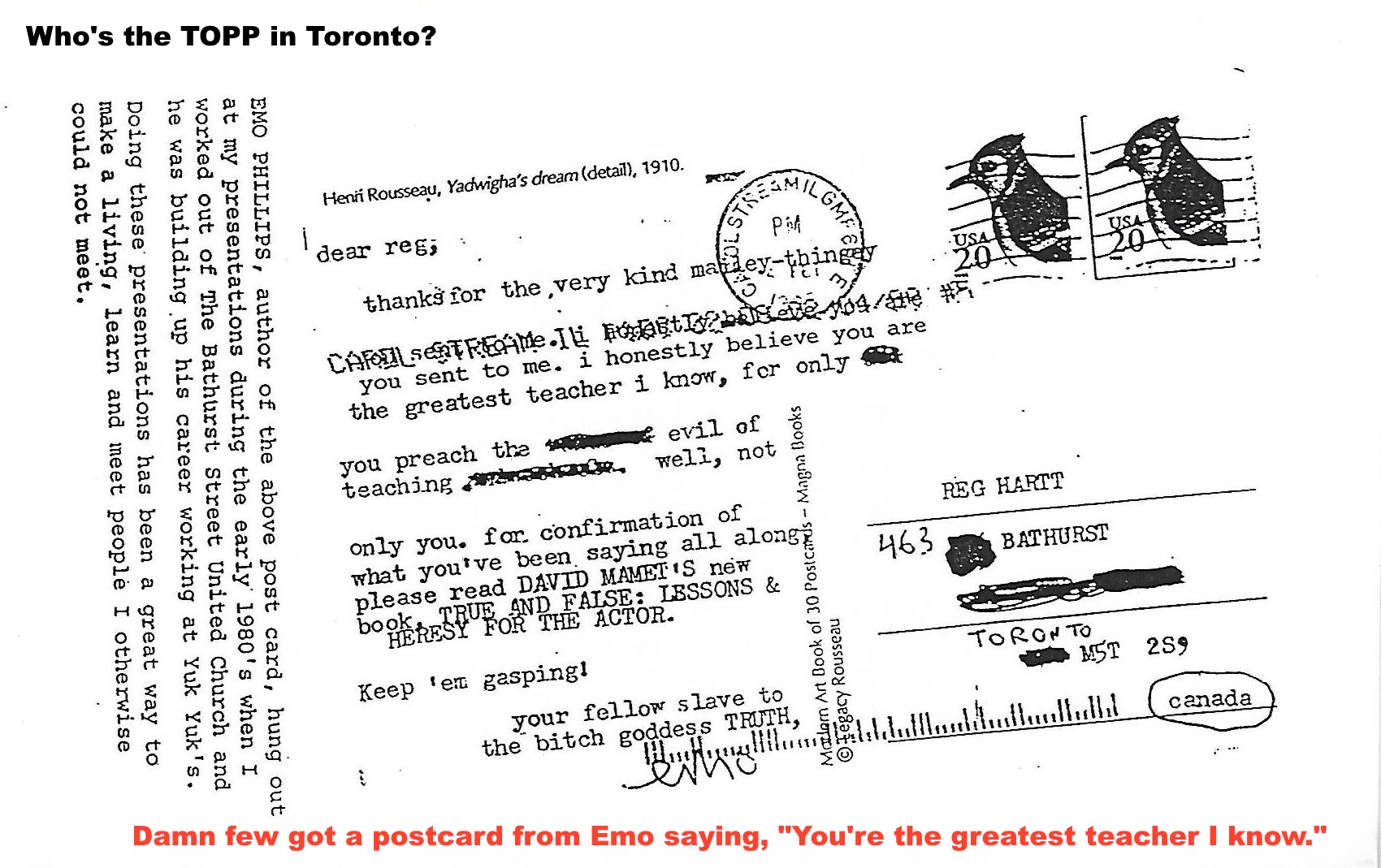
Not only that I personally have experienced and continue to experience a willful turning of a blind eye from the very forces that are called to protect us.
Yes, THE BIRTH OF A NATION (1915) shows the lynching of a Black man, Gus, who has made repeated advances on a woman who has made it clear to him his advances are not welcome. The shade of his skin and hers is not relevant. I don’t believe he meant to rape her. She does not know that. All she knows is that he refuses to take, “no” for an answer. Lynching, for any reason, is wrong. Socrates was lynched in Athens. Jesus of Nazareth was lynched in Jerusalem: https://www.shroud.com/bucklin2.htm . Drop the religious aspects. See him as the man he was. In all these instances the greatest evil was done by people in the name of the greatest good.
Griffith’s own statements in interviews that the Negro had suffered enough and more than enough and that the picture should no longer be shown to the uninformed show a degree of empathy and understanding not found in his detractors.
The problem is the informed are few while the uninformed are huge beyond number,.
Frankly, I see them as a lynch mob.
The uninformed are found ironically at their most venomous in the ranks of Academia.
Copyright © by Holt, Rinehart and Winston. All rights reserved.
What Happened During the Ice Storm
by Jim Heynen
One winter there was a freezing rain. How beautiful! people said when things outside started to
shine with ice. But the freezing rain kept coming. Tree branches glistened like glass. Then broke
like glass. Ice thickened on the windows until everything outside blurred. Farmers moved their
livestock into the barns, and most animals were safe. But not the pheasants. Their eyes froze shut.
Some farmers went ice-skating down the gravel roads with clubs to harvest the pheasants that
sat helplessly in the roadside ditches. The boys went out into the freezing rain to find pheasants
too. They saw dark spots along a fence. Pheasants, all right. Five or six of them. The boys slid
their feet along slowly, trying not to break the ice that covered the snow. They slid up close to the
pheasants. The pheasants pulled their heads down between their wings. They couldn’t tell how
easy it was to see them huddled there.
The boys stood still in the icy rain. Their breath came out in slow puffs of steam. The
pheasants’ breath came out in quick little white puffs. Some of them lifted their heads and turned
them from side to side, but they were blindfolded with ice and didn’t flush. The boys had not
brought clubs, or sacks, or anything but themselves. They stood over the pheasants, turning their
own heads, looking at each other, each expecting the other to do something. To pounce on a
pheasant, or to yell Bang! Things around them were shining and dripping with icy rain. The
barbed-wire fence. The fence posts. The broken stems of grass. Even the grass seeds. The grass
seeds looked like little yolks inside gelatin whites. And the pheasants looked like unborn birds
glazed in egg white. Ice was hardening on the boys’ caps and coats. Soon they would be covered
with ice too.
Then one of the boys said, Shh. He was taking off his coat, the thin layer of ice splintering in
flakes as he pulled his arms from the sleeves. But the inside of the coat was dry and warm. He
covered two of the crouching pheasants with his coat, rounding the back of it over them like a
shell. The other boys did the same. They covered all the helpless pheasants. The small gray hens
and the larger brown cocks. Now the boys felt the rain soaking through their shirts and freezing.
They ran across the slippery fields, unsure of their footing, the ice clinging to their skin as they
made their way toward the blurry lights of the house.
“What Happened During the Ice Storm” by Jim Heynen from You Know What Is Right. Copyright © 1985 by
Jim Heynen. Originally appeared in Seattle Review. Reprinted by permission of the author.
Imagine the outcome had that first had done what most do. Instead of being saved every bird would have been killed and served for dinner.
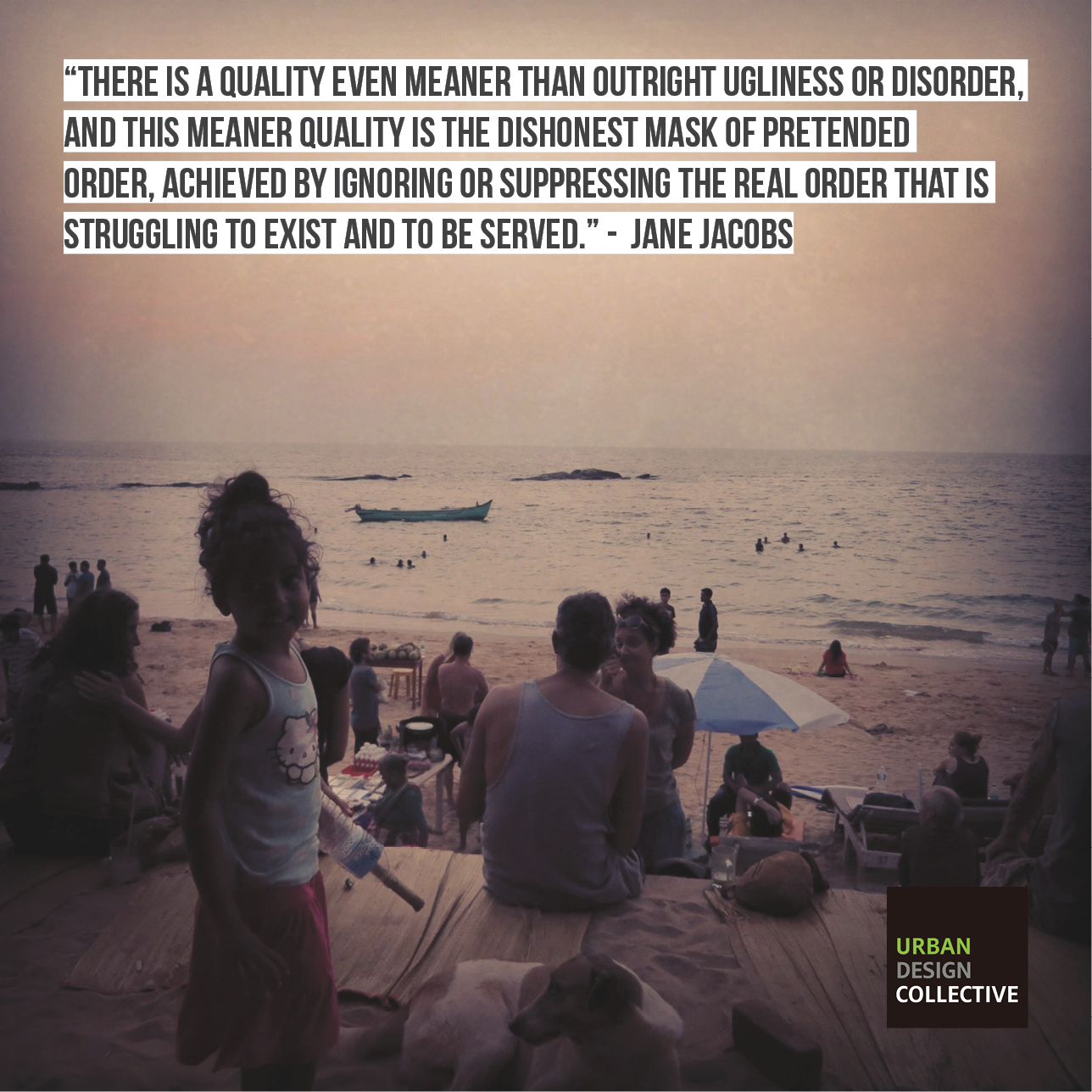
“I had wonderful teachers in the first and second grades who taught me everything I know. After that, I’m afraid, the teachers were nice, but they were dopes…I have a lack of ideology, and not because I have an animus against any particular ideology; it’s just that they don’t make sense to me…they get in the way of thinking. I don’t see what use they are…University and uniformity, as ideals, have subtly influenced how people thought about education, politics, economics, government, everything…We are misled by universities and other intellectual institutions to believe that there are separate fields of knowledge. But it’s clear there are no separate fields of knowledge. It is a seamless web.”-Jane Jacobs whose books, from her first, THE DEATH AND LIFE OF THE GREAT AMERICAN CITIES to her last, DARK AGE AHEAD, are must reading. https://lvassembly.files.wordpress.com/2018/10/underground-history-of-america-education.pdf .
Our school systems are factories for the willfully uninformed.
I am not alone in saying this.
For the sake of a bowl of porridge birthrights are sold.
–Reg Hartt
“My schooling not only failed to teach me what it professed to be teaching, but prevented me from being educated to an extent which infuriates me when I think of all I might have learned at home by myself.”–George Bernard Shaw.
“Men are born ignorant, not stupid. They are made stupid by education,” adds Bertrand Russell.
“School is an institution built on the axiom that learning is the result of teaching. And institutional wisdom continues to accept this axiom, despite overwhelming evidence to the contrary,”–Ivan Illich.
“We get three educations. The first is from our parents; the second is from our schoolmasters. The third is from life. The last makes liars of the first two.”–Montesquieu.
« The one rock bottom solid reason THE BIRTH OF A NATION (1915) can not be called a racist motion picture. Boiled down to its essence David Wark Griffith’s THE BIRTH OF A NATION (1915) is about a woman’s right to say, “No.” »